South Korea

South Korea travel guide: trip costs, safety and exchange rates

Is South Korea right for you?

South Korea is one of the easiest countries in Asia to travel on your own. Trains leave on time, the subway covers Seoul and Busan, and the streets are safe late at night. Food is the best reason to come, from barbecue grilled at your table to tteokbokki (spicy rice cakes) at market stalls. Expect to swap apps: Google Maps gives no walking or driving directions in Korea, so plan routes on Naver Map or KakaoMap.

It suits city breaks, food trips and a first trip to Asia, since transit signs are in English and cards work almost everywhere. Pair Seoul with Busan, then add Gyeongju for temples and royal tombs or Jeju for the coast and hiking. It is a poor fit if the beach is the point: the swimming season is short and falls in the wettest weeks of the year.

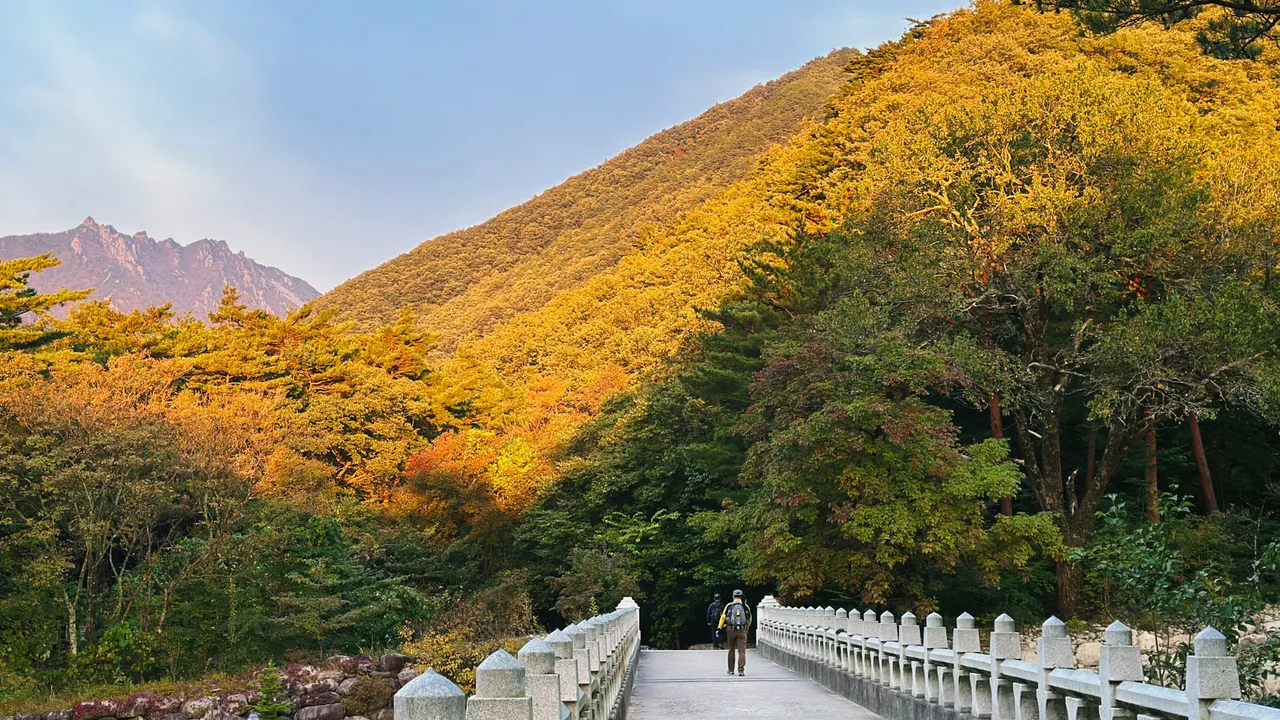
Autumn color along a stone bridge in Seoraksan National Park

South Korea Right Now

Last updated 1 November
Weather
Cool late autumn
Clear, dry days with crisp air and sharply cooler nights. Rain is infrequent, though mornings grow progressively colder across the mainland.
Late Autumn
Heads up

Transport work-to-rule action affects the Airport Railroad line connecting Seoul Station to Incheon Airport.

Allow extra time for airport transit or consider express bus connections.
Transport
Currency
1 USD = 1,343 KRW
Rate is lower than usual. You're getting fewer South Korean won than on most days this year.
Year low 1,324Year high 1,558
Send money to South Korea
Bad rate
−7.4%vs 12-month average
Popularity
Growing

Interest in travel to South Korea rose 14% from a year ago, suggesting demand is growing.

Google Trends travel searches · last 24 months
+14%vs last year

When to go to South Korea

April, May, September and October are the best months across the country. July is the rainy season, and typhoons are most likely in August and September, when they hit Jeju and the south coast hardest. In winter, Seoul drops below freezing at night.

Best monthsAvoid

RegionJanFebMarAprMayJunJulAugSepOctNovDec
SeoulAvoid2°3 rainy daysFine5°3 rainy daysFine11°5 rainy daysBest month18°6 rainy daysBest month24°7 rainy daysFine28°8 rainy daysAvoid29°13 rainy daysAvoid30°12 rainy daysBest month26°6 rainy daysBest month20°5 rainy daysFine12°6 rainy daysFine4°4 rainy days
BusanFine8°4 rainy daysFine10°4 rainy daysFine14°6 rainy daysBest month18°7 rainy daysBest month22°7 rainy daysFine25°8 rainy daysAvoid28°11 rainy daysAvoid30°10 rainy daysFine26°7 rainy daysBest month23°4 rainy daysBest month17°4 rainy daysFine10°3 rainy days
JejuFine9°8 rainy daysFine10°7 rainy daysFine13°8 rainy daysBest month18°8 rainy daysBest month22°7 rainy daysFine25°9 rainy daysAvoid29°9 rainy daysAvoid30°10 rainy daysFine26°8 rainy daysBest month22°5 rainy daysFine16°7 rainy daysFine11°8 rainy days

Each month shows the average daily high, and a weather icon with the number of rainy days.

Need to Know

Population
51,817,000 Statistics Korea · 2025 Census
International visitors
18,936,562 (2025) +15.7% YoY Korea Tourism Organization · Last updated: 2026
Annual visitors per resident
0.37× Annual international visitors divided by the population

Top visitor markets

  • China 28.9%
  • Japan 19.3%
  • Taiwan 10.0%
  • United States 7.8%
  • Hong Kong 3.3%
Show fewer Show 5 more
  • Philippines 3.2%
  • Vietnam 2.9%
  • Singapore 2.1%
  • Indonesia 1.9%
  • Thailand 1.8%

Source: Korea Tourism Organization · 2025

Annual visitor arrivals

  • 2019 17,502,756
  • 2020 2,519,118 COVID
  • 2021 967,003 COVID
  • 2022 3,198,017 COVID
  • 2023 11,031,665
  • 2024 16,369,629 +48.4%
  • 2025 18,936,562 +15.7%

International visitor arrivals. COVID years (2020-2021) are included for completeness. Source: Korea Tourism Organization · Last updated: 2026

Currency
South Korean Won (KRW)
Language
Korean. Signs on transit and in central Seoul are also in English; spoken English is limited outside hotels and tourist areas.
Tap water
Safe to drink
Time zone
GMT+9 (KST)
Power plug
Type C / F, 220V
Dialing code
+82
Driving side
Right
Tipping
Not expected. Some upscale hotels and restaurants add a 10% service charge to the bill.
Internet
Fast 5G and LTE across the country, including in subway tunnels. Free Wi-Fi in most cafes, stations and on intercity trains.
Emergency
112 (Police), 119 (Fire and ambulance), 1330 (Tourist helpline, 24 hours)

When not to go

  • Monsoon and typhoon season

    Late Jun to Sep · rain peaks in Jul

    Jangma (the summer rainy season) usually reaches Jeju in late June and Seoul a few days later. It brings heavy downpours for about a month. August is hot and sticky. Typhoons that reach Korea in August and September hit Jeju and the south coast hardest and can cancel flights and ferries for a day or two. Hiking and long days at the palaces suffer most.

    Go here instead:

    • Japan Hokkaido has no rainy season and stays mild in July and August.
  • Seollal and Chuseok send the country home

    Lunar calendar · 3 days each

    Seollal, the Lunar New Year, falls between late January and mid-February, and Chuseok, the harvest festival, between mid-September and early October. Both send millions of people to their family homes at once. KTX and express-bus seats sell out weeks ahead, expressways jam, and banks, many family restaurants and traditional markets close for the main days. Seoul gets quiet, the main palaces stay open and the convenience stores keep the city fed. It is a good time for a slow week in Seoul and a bad one for traveling around the country.

  • Fine dust in late winter and spring

    Feb to May · varies day to day

    On bad days, fine dust and yellow dust blown in from China and the Gobi turn the sky over Seoul gray-yellow and push air quality into the unhealthy range. Koreans check the dust forecast like the weather, on the AirKorea app or in Naver, and wear masks when it is high. It comes and goes over a few days, so it rarely spoils a whole trip, but if you have asthma, watch the forecast and keep indoor plans ready.

Upcoming Holidays

25
DEC
Christmas Day
A public holiday that Koreans treat more as a night out for couples than a family day. Banks close, while restaurants and shopping streets are busy.
Public holidayLow impact
1
JAN
New Year's Day
Banks and government offices close; shops, restaurants and sights stay open. Crowds gather on the east coast to watch the first sunrise of the year.
Public holidayLow impact
6
FEB
Seollal (Lunar New Year)
Seollal runs from 6 to 8 February, and Tuesday 9 February is also a day off because the main day falls on a Sunday. Trains and buses out of Seoul sell out weeks ahead, and many family restaurants and markets close on the main day. The palaces and big shopping areas stay open.
Public holidayHigh impact Worth timing around
1
MAR
Independence Movement Day
Marks the 1919 protests against Japanese colonial rule, which began with a declaration read in Seoul's Tapgol Park. Banks close; shops and sights stay open.
Public holidayLow impact
1
MAY
Labor Day
A public holiday since 2026. It falls on a Saturday in 2027, so Monday 3 May is the day off. Banks close; shops and sights stay open.
Public holidayLow impact
5
MAY
Children's Day
Parks, zoos and theme parks such as Everland and Lotte World fill up with families. Visit family attractions on another day if you can.
Public holidayMedium impact
13
MAY
Buddha's Birthday
Temples hang thousands of paper lanterns, and Jogyesa in central Seoul is the busiest. Seoul's Lotus Lantern Festival parade is usually held on a weekend before the holiday.
Public holidayMedium impact Worth timing around
6
JUN
Memorial Day
Honors those who died in military service. A siren sounds across the country at 10 a.m. for a minute of silence. Banks close; everything else runs as normal.
Public holidayLow impact
17
JUL
Constitution Day
A public holiday again since 2026, for the first time since 2008. It falls on a Saturday in 2027, so Monday 19 July is the day off.
Public holidayLow impact
15
AUG
Liberation Day
Marks the end of Japanese rule in 1945. It falls on a Sunday in 2027, so Monday 16 August is the day off. It lands in the summer school holidays, so beaches and resorts are busy.
Public holidayLow impact
14
SEP
Chuseok (harvest festival)
The autumn harvest festival runs from 14 to 16 September. Intercity trains and buses sell out weeks ahead, and many family restaurants and markets close on the main day.
Public holidayHigh impact Worth timing around
3
OCT
National Foundation Day
Marks the founding of the first Korean kingdom in legend. It falls on a Sunday in 2027, so Monday 4 October is the day off.
Public holidayLow impact
9
OCT
Hangul Day
Celebrates Hangul, the Korean alphabet created under King Sejong in the 15th century. It falls on a Saturday in 2027, so Monday 11 October is the day off.
Public holidayLow impact

South Korea Visa & Entry

Visa type
Visa-free entry for most Western passports. Some nationalities also need a K-ETA (Korea Electronic Travel Authorization), applied for online before you fly.
Length of stay
90 days for US, UK, Australian and most EU passports. Canadians get 180 days.
Extension
Not normally possible on a visa-free stay. Immigration offices extend only in exceptional cases, such as illness.
Passport validity
Valid for your whole stay.
Onward ticket
Officers can ask for a return or onward ticket, so have one booked.
Tourist tax
None.
Eligible nationalities
22 countries and territories are exempt from the K-ETA until 31 December 2026, including the US, UK, Canada, Australia, New Zealand, Japan, Singapore, Taiwan, France, Germany, Italy, Spain and the Netherlands. Other visa-free nationals apply for a K-ETA before flying. The US State Department says Americans will need a K-ETA again from 1 January 2027 unless Korea extends the exemption.
Entry process

Immigration and entry process

Fill in the free e-Arrival card online up to 3 days before you land, unless you hold an approved K-ETA, which replaces it. Visitors from exempt countries who did not apply for a K-ETA still fill in the card.

Immigration takes your fingerprints and a photo. The K-ETA costs KRW 10,000 on the official site. It is valid for three years, or until your passport expires if that comes first, and approval can take up to 72 hours. Lookalike sites charge over USD 100 for the same thing.

Source: Korea Electronic Travel Authorization (K-ETA)

Getting To South Korea

  • From Incheon International (ICN)

    On an island about 50 km west of central Seoul, 45 to 90 minutes into the city

    Almost every long-haul flight lands at Incheon. The AREX airport railway runs from both terminals to Seoul Station: the express skips the stops, and the slower all-stop train connects to the subway on the way. Buy a T-money card at a convenience store in arrivals before you leave the terminal. It pays for the all-stop train, the subway, buses and most taxis.

    • AREX express train to Seoul Station: 43 min from Terminal 1, 51 min from Terminal 2, KRW 13,000
    • AREX all-stop train to Seoul Station: 59 min and KRW 4,750 from Terminal 1, 66 min and KRW 5,350 from Terminal 2, with a transit card
    • Airport limousine bus to central districts and large hotels: 60 to 90 min, about KRW 17,000
    • Taxi to central Seoul: about 60 min, KRW 65,000 to 100,000 including tolls
  • From Gimpo International (GMP)

    Seoul's second airport, inside the city, for domestic flights and short hops from Japan, China and Taiwan

    Gimpo handles Seoul's domestic flights, including to Jeju and Busan, and a few short international routes. It is on the subway network, so you can be in central Seoul in under 40 minutes without a taxi.

    • AREX train to Seoul Station: about 22 min
    • Subway Line 5 or Line 9: 20 to 40 min to central Seoul
    • Taxi to central Seoul: 30 to 50 min, about KRW 20,000 to 38,000
  • From Gimhae International (PUS)

    Busan's airport, on the west side of the city

    Gimhae has direct flights from Japan, China and Southeast Asia as well as domestic ones. The light rail to Sasang connects to Busan's metro, and a transfer within 30 minutes costs nothing extra.

    • Light rail to Sasang, then the metro: about 15 min to Sasang, KRW 1,600 to 1,800 by card
    • Limousine bus to Haeundae: about an hour, KRW 9,500
    • Taxi to central Busan: KRW 25,000 to 35,000
  • From Jeju International (CJU)

    On the edge of Jeju City, the gateway to the island

    Gimpo to Jeju is the busiest air route in the world, and there are also direct flights from Japan, China and Taiwan. There are no trains on Jeju, so most visitors rent a car or use the island's buses.

    • Bus 100 or 500 to Jeju City: KRW 1,500 by card
    • Taxi to Jeju City: 10 to 15 min, about KRW 8,000 to 10,000

Safety Advice

82/100

Very safe. Violent crime against visitors is rare and the streets stay busy late. The risks are traffic, delivery scooters on the sidewalk and the odd late-night scuffle in nightlife districts. North Korea makes headlines but does not affect travel.

Travel Advisories100
Crime73
Global Peace Index68
Murder Rate97
Disaster Risk78
Traffic88
Women's Safety87
LGBTQ52
How this score is built ↗

Travel Advisories

Source: US State Department. Always verify current advice before traveling.

Source: UK FCDO. Always verify current advice before traveling.

Source: Global Affairs Canada. Always verify current advice before traveling.

Source: Auswärtiges Amt. Always verify current advice before traveling.

Natural disasters

  • Typhoons occur from June to November, so monitor forecasts through the Korea Meteorological Administration and follow local instructions.
  • Summer monsoon rains cause floods and landslides, so avoid rivers and mountain areas during heavy downpours.
  • Earthquakes happen occasionally, so check local safety procedures for shelter locations during tremors.

Unrest & security

  • Political tensions with North Korea flare up around military exercises and missile tests, so keep track of local news broadcasts.
  • Public protests happen often and foreigners are legally banned from joining local political activities.
  • Dual nationals of Korean descent may face mandatory military service obligations regardless of their travel passport.

Transport & infrastructure

  • You need both your home country driving license and a 1949 international driving permit to rent or drive a car.
  • Drivers involved in accidents with pedestrians or cyclists face criminal charges, and blood alcohol limits are extremely strict.
  • Keep your destination written in Korean because most taxi drivers do not speak English.

Other notes

  • Drug offenses carry severe prison sentences and heavy fines, and police use drug tests that can lead to immediate detention.
  • Theft occurs in crowded areas and nightlife districts like Itaewon, so watch your belongings closely after dark.

Always check your own government's official travel advice before traveling.

Money & Payments

Cards work almost everywhere, taxis included. Keep some cash for markets and street food, and load a T-money card for transit.

  • Foreign cards work almost everywhere

    Visa and Mastercard are taken in hotels, restaurants, convenience stores, shops and most taxis. Traditional markets and street stalls are the main exceptions, so keep a few 10,000-won notes for those.

  • T-money for the subway and buses

    You cannot tap a foreign card at subway gates or on buses. Buy a T-money card at a CU, GS25 or 7-Eleven and top it up there with cash. It also pays for most taxis and convenience-store shopping. On an iPhone, the mobile T-money card can be topped up with some foreign cards, though not all card networks are accepted.

  • Use a Global ATM

    Look for ATMs marked Global ATM at banks, stations and convenience stores. The machine charges about 3,000 to 6,000 won per withdrawal, and your own bank may add its own fee on top. Convenience-store machines often cap a withdrawal at 100,000 to 300,000 won; bank ATMs allow more.

  • Always pay in won

    When a card machine or ATM offers to charge you in your home currency, decline and pay in won. The home-currency option uses a worse exchange rate.

  • Tax refund on shopping

    Shops with a Tax Free sign refund the VAT on purchases of 15,000 won or more. Many take it off the price at checkout, for purchases under 1 million won and up to 5 million won per trip. For anything else, claim the refund at the airport before you check in.

Costs in South Korea

58/100

Seoul hotels cost more than in most of Asia, but food, transit and palace tickets are good value. Barbecue dinners, taxis and a rental car on Jeju are where a budget goes.

Hotel 3-star (per night)$107
Travelodge Myeongdong Euljiro (Jung-gu), Kayak (Seoul)
From USD 182 per night, 3-star filter, Oct 31 to Nov 1 2026 (Saturday night); KRW 241,200 at 1,325.28 KRW/USD
Best Western Haeundae Hotel (Haeundae), Kayak (Busan)
From USD 82 per night, Oct 31 to Nov 1 2026; listed in Kayak's 3-star group at USD 62; used 82; KRW 108,700 at 1,325.28 KRW/USD
Hi Residences (Jeju City), Kayak (Jeju)
USD 64 per night in Kayak's 3-star best-value group, date not stated; KRW 84,800 at 1,325.28 KRW/USD
Average (inc. tax & service)$107

Average of the 3 places we track: Seoul, Busan, Jeju. Central Seoul, around Myeongdong, is the most expensive base, and weekend nights cost more than weekdays.

Last checked on: October 2026

Hotel 5-star luxury (per night)$396
Lotte Hotel Seoul (Jung-gu), Kayak (Seoul)
From USD 557 per night, Oct 31 to Nov 1 2026; KRW 738,200 at 1,325.28 KRW/USD
Grand Josun Busan (Haeundae), Kayak (Busan)
From USD 278 per night, Oct 31 to Nov 1 2026; KRW 368,400 at 1,325.28 KRW/USD
Grand Hyatt Jeju (Jeju City), Kayak (Jeju)
From USD 371 per night, Oct 24 to 25 2026; KRW 491,700 at 1,325.28 KRW/USD
Average (inc. tax & service)$396

Average of the 3 places we track: Seoul, Busan, Jeju. The flagship hotels in central Seoul cost the most, and Busan's beachfront five-stars cost the least of the three.

Last checked on: October 2026

Airbnb 1-bed (per night)$78
Double.Hongdae 2mins, best location (Sinchon-dong), Airbnb (Seoul)
KRW 111,800 per night (was KRW 126,149), entire place, 1 bedroom, Nov 10 to 11 2026
Gunam-ro high-floor Haeundae sea view apartment (Haeundae-gu), Airbnb (Busan)
KRW 95,000 per night (was KRW 113,409), entire apartment, 1 bedroom, Nov 10 to 11 2026
Uju Stay, Sinheung (Hamdeok), Airbnb (Jeju)
KRW 107,800 per night, entire place, 1 bedroom, Nov 10 to 11 2026
Average (inc. tax & service)$78

Average of the 3 places we track: Seoul, Busan, Jeju. The three cities sit within about KRW 17,000 of each other for a plain one-bedroom; sea views and hanok houses cost far more.

Last checked on: October 2026

Hostel dorm (per night)$15.77
Zzzip Guesthouse in Hongdae (Mapo-gu), Hostelworld (Seoul)
Dorms from EUR 15.68, no date shown; KRW 23,200 at 1,482.72 KRW/EUR
Blue Backpackers Hostel, Hostelworld (Busan)
Dorms from EUR 13.63, no date shown; KRW 20,200 at 1,482.72 KRW/EUR
Ttottot Jeju Backpackers, Hostelworld (Jeju)
Dorms from EUR 13.56, no date shown; KRW 20,100 at 1,482.72 KRW/EUR
Average (inc. tax & service)$15.77

Average of the 3 places we track: Seoul, Busan, Jeju. Busan and Jeju dorm beds cost about the same, and Seoul's Hongdae hostels cost a few thousand won more.

Last checked on: October 2026

Local restaurant meal$7.44
Ouga (Myeongdong), Kakao Map menu (Seoul)
Kimchi jjigae set meal (김치찌개정식) KRW 11,000
Pohang Dwaeji Gukbap (Seomyeon), Kakao Map menu (Busan)
Dwaeji gukbap (돼지국밥) KRW 10,000
Samdae Jeontong Gogi Guksu (Jeju City), Kakao Map menu (Jeju)
Gogi guksu (고기국수) KRW 9,000
Average (inc. tax & service)$7.44

Average of the 3 places we track: Seoul, Busan, Jeju. A bowl of pork-bone soup or noodles costs about the same everywhere, and Jeju's gogi guksu (pork broth noodles) is the cheapest of the three at KRW 9,000.

Last checked on: October 2026

Beer local (at a bar)$4.09
Bierhalle Euljiro (Jung-gu), Kakao Map menu (Seoul)
Cass draft (Cass생맥주) KRW 6,000
Hunhyeok (Seomyeon), Kakao Map menu (Busan)
Beer, Terra (맥주(테라)) KRW 5,000
Average (inc. tax & service)$4.09

Average of the 2 places we sourced: Seoul and Busan. A pint of Cass draft at a central Seoul beer hall costs KRW 6,000, about KRW 1,000 more than a Terra in a Busan bar.

Last checked on: October 2026

Scooter rental (per day)$29.75
Jeju June Bike (Jeju City) (Jeju)
Own rental list, 24-hour prices: Benly 110cc KRW 40,000; Vbon 125cc KRW 40,000; Lumi 125 and Modena 125 KRW 45,000; all-new PCX and NMAX 125 KRW 50,000; 2025-26 PCX/NMAX KRW 55,000; 50cc models KRW 30,000. Rental guide: 240 km limit per 24 hours, KRW 5,000 per day for a passenger.
Average (inc. tax & service)$29.75

Jeju is the only one of the 3 places where shops rent scooters to visitors, and you need a license valid for motorcycles in Korea. A 110 to 125cc scooter costs about KRW 40,000 for 24 hours, a newer PCX or NMAX KRW 50,000 to 55,000.

Last checked on: October 2026

Taxi / ride-share (5km)$5.18
Seoul Metropolitan Government, mid-size taxi tariff (Seoul)
Day fare since 1 Feb 2023: KRW 4,800 for the first 1.6 km, then KRW 100 per 131 m, plus KRW 100 per 30 seconds below 15 km/h. Math: 5,000 m minus 1,600 m = 3,400 m; 3,400 / 131 = 25.95, so 25 completed increments = KRW 2,500. 4,800 + 2,500 = KRW 7,300 (no time charge assumed).
Busan Metropolitan City, mid-size taxi tariff (Busan)
Fare since 1 Jun 2023: KRW 4,800 for the first 2 km, then KRW 100 per 132 m, plus KRW 100 per 33 seconds when slow. Math: 5,000 m minus 2,000 m = 3,000 m; 3,000 / 132 = 22.7, so 22 increments = KRW 2,200. 4,800 + 2,200 = KRW 7,000.
Jeju Special Self-Governing Province, taxi fares and rates (Jeju)
Fare since 1 Jul 2024: KRW 4,300 for the first 2 km, then KRW 100 per 126 m, plus KRW 100 per 31 seconds below 15 km/h. Math: 3,000 m / 126 = 23.8, so 23 increments = KRW 2,300. 4,300 + 2,300 = KRW 6,600.
Average (inc. tax & service)$5.18

Average of the 3 places we track: a 5 km daytime ride in a regular taxi is about KRW 7,300 in Seoul, KRW 7,000 in Busan and KRW 6,600 on Jeju, before any time charge for slow traffic. Late-night surcharges add 20 to 40 percent.

Last checked on: October 2026

Rent 1-bed (monthly)$386
Daangn Realty listing 4712562 (Seogyo-dong, Mapo) (Seoul)
Open-plan one-room, 23 m2, 1st floor, 5 min walk to Hongik Univ. station: deposit KRW 20,000,000, rent KRW 650,000/month. This is the median rent of the first 15 Seogyo-dong one-room monthly listings (range KRW 400,000 to 1,200,000).
Daangn Realty listing 4820671 (Bujeon-dong, Seomyeon) (Busan)
Separate-kitchen one-room, 16 m2, 8 min walk to Seomyeon station: deposit KRW 5,000,000, rent KRW 420,000/month. Median of the first 15 Bujeon-dong one-room listings (range KRW 320,000 to 550,000).
Daangn Realty listing 4845367 (Nohyeong-dong) (Jeju)
Separate-room one-room, 24 m2, 2nd floor: deposit KRW 3,000,000, rent KRW 490,000/month. Median of the first 15 Nohyeong/Yeon-dong one-room listings (range KRW 420,000 to 600,000).
Average (inc. tax & service)$386

Average of the 3 places we track: a one-room studio near the center rents for about KRW 650,000 in Seoul, KRW 420,000 in Busan and KRW 490,000 in Jeju City a month. Expect a deposit of KRW 3 to 20 million on top, and maintenance fees are usually extra.

Last checked on: October 2026

Local gym (monthly)$71
Infinity Gym Daeheung (Mapo) (Seoul)
Own price list on its Daangn business profile: gym 1 month KRW 66,000, includes workout clothes, towel, day locker and shower; 3 months KRW 132,000.
Jeongseok Fitness Haeundae (U-dong, Haeundae) (Busan)
Own price list (last updated 5 Sep 2026): gym 1 month with clothes and towel KRW 100,000; 3 months KRW 210,000; day pass KRW 20,000.
Anytime Fitness Jeju Samhwa (Doryeon-dong, Jeju City) (Jeju)
Own price list: 1 month, no auto-renewal, 24-hour access KRW 119,000; one-time key fob KRW 50,000; auto-renewing monthly subscription from KRW 49,000.
Average (inc. tax & service)$71

Average of the 3 places we track: a one-month gym pass costs about KRW 66,000 in Seoul, KRW 100,000 in Busan and KRW 119,000 on Jeju. Signing up for 3 months or more cuts the monthly price by a third or more.

Last checked on: October 2026

SIM card tourist (7-day)$26.03
KT Korea SIM / eSIM, roaming centers and online (national)
KT user guide dated July 2026: data-only plan 7 days (168 h) KRW 35,000 (5 days KRW 27,500, 10 days KRW 38,500); call + SMS + data plan 7 days KRW 40,500 with KRW 16,500 voice credit included. 11 GB/day high speed, then 5 Mbps.
Average (inc. tax & service)$26.03

KT's tourist SIM or eSIM costs KRW 35,000 for 7 days of data, with 11 GB a day at full speed and unlimited at 5 Mbps after that. The version with a Korean number for calls and texts is KRW 40,500.

Last checked on: October 2026

1-hour massage$43.36
Natural Thai Spa Yeoksam (Gangnam) (Seoul)
Own price list (updated 11 Oct 2026): traditional Thai massage 60 min KRW 55,000; herbal ball 60 min KRW 77,000; deep tissue oil 60 min KRW 88,000.
HT Healing Touch Care (Jung-dong, Haeundae) (Busan)
Own price list (updated 9 Oct 2026): full-body basic 60 min KRW 60,000; full-body focus 80 min KRW 80,000.
Body Aroma (Ido-dong, Jeju City) (Jeju)
Own price list (updated 9 Oct 2026): Aroma A 60 min oil massage KRW 60,000 cash price; traditional full-body 60 min dry massage KRW 50,000.
Average (inc. tax & service)$43.36

Average of the 3 places we track: a 60-minute massage costs about KRW 55,000 for Thai massage in Gangnam, KRW 60,000 for a full-body massage in Haeundae and KRW 60,000 for an aroma oil massage in Jeju City. Oil and aroma treatments usually cost more than dry massage.

Last checked on: October 2026

Co-working space (monthly)$112
Commons Space (Mangwon-dong, Mapo) (Seoul)
Own price list (updated 4 Sep 2026): hot desk 1 month KRW 150,000; window fixed desk KRW 200,000; fixed desk KRW 250,000; day pass KRW 15,000.
Average (inc. tax & service)$112

Hot desks in Seoul run about KRW 150,000 a month. The big chains publish no monthly desk price, so this is a smaller independent space.

Last checked on: October 2026

Dentist checkup$57
Busan New York Dental (Seomyeon, Centum and Gwangan branches) (Busan)
2026 non-covered fee table: full-mouth scaling KRW 60,000; detailed diagnosis KRW 10,000 to 50,000; CT KRW 50,000.
HIRA, Health Insurance Medical Fee Schedule 2026 (national)
Dental clinic first-visit consultation AA100 = 166.59 points x KRW 101.1 per point (dental clinic unit value 2026) = KRW 16,842, rounded to KRW 16,840. Total: 16,840 + 60,000 = KRW 76,840.
Average (inc. tax & service)$57

Without Korean insurance, a dental exam plus full scaling costs about KRW 77,000: the clinic's own scaling price plus the standard first-visit fee. Clinics set their own prices for uninsured patients, so ask before treatment.

Last checked on: October 2026

Doctor / GP checkup$14
HIRA, Health Insurance Medical Fee Schedule 2026 (national)
Clinic (uiwon) first-visit consultation AA154 = 197.12 points x KRW 95.6 per point (clinic unit value 2026) = KRW 18,844.7, rounded to KRW 18,840. Uninsured patients pay 100 percent; clinics may set a higher self-pay rate.
Average (inc. tax & service)$14

The standard first-visit fee at a neighborhood clinic is KRW 18,840 before insurance, and that is roughly what an uninsured visitor pays for a basic consultation. Tests and medicine are extra, and the international clinics at big hospitals can charge more.

Last checked on: October 2026

International preschool (monthly)$2,722
Seoul Foreign School (Yeonhui-dong, Seodaemun) (Seoul)
2026-27 tuition page: Pre-K 4 full day KRW 26,740,000 + USD 12,960 per year. Divided by 12: KRW 2,228,333 + USD 1,080 per month. Pre-K 2/3 partial day KRW 18,280,000 + USD 7,185.
Average (inc. tax & service)$2,722

Full-day Pre-K at Seoul Foreign School works out to about KRW 2.23 million plus USD 1,080 a month, because the school bills every family in both currencies. Entrance and registration fees come on top.

Last checked on: October 2026

International primary school (per year)$33,616
Seoul Foreign School (Yeonhui-dong, Seodaemun) (Seoul)
2026-27 tuition (school year 10 Aug 2026 to 11 Jun 2027): Kindergarten to Grade 5, full day only, KRW 27,285,000 + USD 13,500 per year. Total is the sum of both parts.
Average (inc. tax & service)$33,616

Kindergarten to Grade 5 at Seoul Foreign School costs KRW 27,285,000 plus USD 13,500 a year, billed in both currencies. Application, registration and entrance fees are extra.

Last checked on: October 2026

Price Index46

How local prices compare with a global baseline, based on the World Bank's Price Level Index. It captures what a typical basket of goods and services costs against the world average. The pricier a country is to live in, the lower it scores on the affordability bar here.

GDP per capita (monthly)$2,887

A country's economic output per person, shown per month in US dollars, from IMF, World Bank and UN data. We use it as a rough proxy for local incomes. Where people earn more, rent, wages and services tend to cost more too, so a higher figure usually points to a pricier place to live.

Big Mac$3.99

What a Big Mac costs at a local McDonald's, converted to US dollars. The same burger is cheap in some countries and expensive in others, so it's a quick, familiar read on local prices. We collect these figures ourselves.

Groceries and fuel

Chicken breast (500g)$5.30

Raw chicken breast is sold chilled in 400 g to 600 g trays, with frozen 1 kg bags for less. Chilled breast at Emart works out to about KRW 5,000 to 9,500 per 500 g, about KRW 7,100 on average.

Emart Mall (emart.ssg.com)
냉장 닭가슴살 (chilled chicken breast) 500 g, KRW 5,837
Emart Mall (emart.ssg.com)
무항생제 닭가슴살 (antibiotic-free breast) 400 g, KRW 4,188 = KRW 5,235 per 500 g
Emart Mall (emart.ssg.com)
무항생제 닭가슴살 600 g, KRW 9,480 = KRW 7,900 per 500 g
Emart Mall (emart.ssg.com)
무항생제 닭가슴살 400 g, KRW 7,580 = KRW 9,475 per 500 g
Average (inc. tax)$5.30

Last checked on: October 2026

Dozen eggs$2.58

Eggs come in trays of 10, 15 or 30, not dozens. A 30-egg tray of large eggs costs about KRW 8,000 to 10,000 at Emart, so a dozen works out to about KRW 3,500.

Emart Mall (emart.ssg.com)
알찬란 30구 (large, 1,560 g) KRW 7,880 = KRW 3,152 per 12
Emart Mall (emart.ssg.com)
이맛란 30구 (extra large) KRW 7,980 = KRW 3,192 per 12
Emart Mall (emart.ssg.com)
1등급 30구 (grade 1, extra large) KRW 8,980 = KRW 3,592 per 12
Emart Mall (emart.ssg.com)
행복한 특란 30구 (2 x 15, extra large) KRW 9,900 = KRW 3,960 per 12
Average (inc. tax)$2.58

Last checked on: October 2026

Milk (1L)$2.54

Fresh milk comes in 900 ml or 1 L cartons, with 1.8 L and 2.3 L jugs for families. A 1 L carton of Seoul Milk costs about KRW 3,600, and Maeil's 900 ml carton about KRW 3,000.

Emart Mall (emart.ssg.com)
서울우유 목장의 신선함이 살아있는 우유 1 L, KRW 3,630
Emart Mall (emart.ssg.com)
매일우유 오리지널 900 ml, KRW 2,970 = KRW 3,300 per L
Emart Mall (emart.ssg.com)
서울우유 1.8 L, KRW 5,970 = KRW 3,317 per L
Average (inc. tax)$2.54

Last checked on: October 2026

Yogurt (plain, 500g)$2.14

Plain yogurt is sold in 450 g to 900 g tubs and in 1.8 L pourable bottles that work out cheapest. Expect about KRW 2,000 to 4,000 per 500 g depending on pack size.

Emart Mall (emart.ssg.com)
매일 바이오 설탕무첨가 플레인 450 g, KRW 3,670 = KRW 4,078 per 500 g
Emart Mall (emart.ssg.com)
에이 클래스 플레인요거트 900 g, KRW 5,922 = KRW 3,290 per 500 g
Emart Mall (emart.ssg.com)
불가리스 플레인 요거트 1.8 L, KRW 7,980 = KRW 2,217 per 500 g (1 L taken as 1 kg)
Emart Mall (emart.ssg.com)
서울우유 더 진한 순수 플레인 요거트 1.8 L, KRW 6,980 = KRW 1,939 per 500 g
Average (inc. tax)$2.14

Last checked on: October 2026

White rice (1kg)$2.77

Rice is sold in 4 kg, 10 kg and 20 kg bags, and the new harvest arrives in the fall. A 10 kg bag of 2026 domestic white rice costs about KRW 33,000 to 40,000, around KRW 3,700 per kg.

Emart Mall (emart.ssg.com)
정성가득 경기미 10 kg (2026 harvest), KRW 37,910
Emart Mall (emart.ssg.com)
[26년 햅쌀] 경기미 10 kg, KRW 37,980
Emart Mall (emart.ssg.com)
한눈에 반한 쌀 10 kg, KRW 39,980
Emart Mall (emart.ssg.com)
단일품종미 신동진쌀 10 kg, KRW 32,980
Average (inc. tax)$2.77

Last checked on: October 2026

Bananas (1kg)$2.86

Bananas are imported, mostly from the Philippines and Ecuador, and sold in bunches of about 1 kg. Expect about KRW 3,500 to 5,000 a bunch at Emart.

Emart Mall (emart.ssg.com)
에콰도르산 달콤 바나나 1 kg, KRW 3,980
Emart Mall (emart.ssg.com)
필리핀산 스위트마운틴 바나나 1 kg, KRW 3,500
Emart Mall (emart.ssg.com)
필리핀산 스위티오 바나나 1 kg, KRW 4,980
Emart Mall (emart.ssg.com)
필리핀산 바나나 1.2 kg, KRW 3,480 = KRW 2,900 per kg
Average (inc. tax)$2.86

Last checked on: October 2026

Bottled water (1.5L)$0.59

Korea's standard large bottle is 2 L, and Samdasoo is the best seller. A 2 L bottle costs about KRW 1,080 at Emart (about KRW 800 per 1.5 L), while convenience stores charge about KRW 1,900 for 2 L.

Emart Mall (emart.ssg.com)
삼다수 2 L (no label) single bottle, KRW 1,080 = KRW 810 per 1.5 L
Emart Mall (emart.ssg.com)
삼다수 2 L x 12, KRW 12,960 = KRW 1,080 per 2 L = KRW 810 per 1.5 L
CU (convenience store)
농심 백산수 2 L, KRW 1,900 = KRW 1,425 per 1.5 L (convenience-store price, not used in the value)
emart24 (convenience store)
농심 백산수 2 L KRW 1,900; 롯데 아이시스 8.0 2 L KRW 1,950 (convenience-store prices, not used in the value)
Average (inc. tax)$0.59

Last checked on: October 2026

Beer (supermarket, 330ml)$1.33

Korean lagers like Cass, Cloud and Kelly come in 355 ml and 500 ml cans. At a convenience store a 500 ml can of a domestic lager costs about KRW 2,750 to 2,800, which is about KRW 1,800 per 330 ml, and multi-can deals bring it lower.

emart24 (convenience store)
롯데 클라우드 캔맥주 500 ml, KRW 2,750 = KRW 1,815 per 330 ml
emart24 (convenience store)
오비라거 뉴트로 캔맥주 500 ml, KRW 2,800 = KRW 1,848 per 330 ml
emart24 (convenience store)
롯데 크러시 캔맥주 355 ml, KRW 2,250 = KRW 2,092 per 330 ml
emart24 (convenience store)
하이트 테라 캔 452 ml x 6 bundle, KRW 11,500 = KRW 1,917 per can = KRW 1,400 per 330 ml
Average (inc. tax)$1.33

Last checked on: October 2026

Pack of cigarettes$3.35

A pack of 20 domestic cigarettes costs KRW 4,500 for most brands, including Esse, the best seller. The maker sets the price, so it is the same at every convenience store.

KT&G half-year report 2026 (DART filing, 반기보고서 2026.06, II. 사업의 내용 > 주요 제품 등의 가격변동추이)
Domestic consumer price per pack: 에쎄 체인지 1mg KRW 4,500; 에쎄 체인지 히말라야 KRW 4,500; MIIX 믹스 KRW 4,500; Fiit 체인지업 KRW 4,300; AIIM 트와이스 KRW 4,800
Average (inc. tax)$3.35

Last checked on: October 2026

Wine (mid-range bottle)$11.53

Imported wine is much pricier than in Europe because of import taxes. A mid-range bottle from Chile, Argentina or California costs about KRW 11,000 to 20,000 at Emart or a convenience store.

Emart Mall (emart.ssg.com)
트라피체 말벡 (Trapiche Malbec) 750 ml, KRW 12,800 (store pickup)
Emart Mall (emart.ssg.com)
코노수르 비씨클레타 까베르네 소비뇽 (Cono Sur Bicicleta) 750 ml, KRW 16,500
emart24 (convenience store)
베어풋 카베르네소비뇽 (Barefoot) 750 ml, KRW 16,900; 무똥까데 루즈 (Mouton Cadet) 750 ml, KRW 20,000
emart24 (convenience store)
프론테라 프리미엄 까베네쇼비뇽 (Frontera) 750 ml, KRW 10,900 to 12,000
Average (inc. tax)$11.53

Last checked on: October 2026

Gasoline (1 litre)$1.38

Regular gasoline averages about KRW 1,856 a liter nationwide, with Seoul about KRW 1,900. Prices change daily and range from about KRW 1,765 to over KRW 2,500 a liter between stations.

Opinet (Korea National Oil Corporation)
오늘의 유가 2026-10-27: 휘발유 전국평균 KRW 1,855.66/L (서울평균 KRW 1,901.16/L; lowest KRW 1,765, highest KRW 2,549)
Average (inc. tax)$1.38

Last checked on: October 2026

Send money to South Korea

See today's KRW rate and what you'll actually receive after fees.

See live rates from Wise, Remitly, Western Union + more

Save money?

Sign up for our guide on how to save money on your next trip.

SIM Cards & Data

Best option for most travelers: an eSIM you set up before you arrive. You'll be online the moment you land, with no airport line and no tourist pricing.

Travel eSIMs Connect the second you land. Zero hassle. Skip the airport line and paperwork. Activate before you fly and land connected. Find the best eSIM →

Prefer a local SIM?

5G and LTE cover the cities, the KTX lines and the subway tunnels. Signal is weakest on remote mountain trails. All three carriers have counters on the arrivals floor at Incheon, and you need your passport to buy a SIM or eSIM. Prices below are for tourist data plans and change often.

  • SK Telecom

    Largest network

    SK Telecom is the largest carrier and the default pick. Its tourist plans come as a SIM or eSIM, collected at the Incheon counters or ordered online before you fly.

    5-day unlimited data: about KRW 27,500

  • KT

    Second-largest network

    KT's unlimited plans slow down after a daily allowance, so read the plan details. In the cities and along the main routes, its coverage is as good as SK Telecom's.

    5-day data: about KRW 24,700

  • LG U+

    Shortest plans

    LG U+ sells plans as short as a single day, which suits a stopover or a short trip from Japan. Its signal is as reliable as the other two in the cities and along the main routes.

    1-day unlimited data: KRW 6,500

Liveability

65/100

Fast internet everywhere, clean and punctual transit and free public toilets make daily life easy. The friction is apps: maps, taxis and delivery work best on Korean apps, and some want a Korean phone number.

Happiness 62

A country-level read of how satisfied residents say they are with their own lives, from the annual World Happiness Report survey. Higher means happier.

Source: World Happiness Report (SDSN)

Getting by in English 57
Corruption 70

How clean the public sector is seen to be, from Transparency International's Corruption Perceptions Index. A higher score means less corruption in everyday dealings with officials and institutions.

Source: Corruption Perceptions Index (Transparency International)

Income equality 81

How evenly income is spread across the population, based on the World Bank's Gini index. A higher score means a smaller gap between the richest and poorest.

Source: Gini Index (World Bank)

Gender equality 54

How equally the country treats women and men across health, empowerment and the labor market, from the UN's Gender Inequality Index. Higher means more equal.

Source: Gender Inequality Index (UNDP)

Press freedom 69

How freely the press can report without censorship or reprisal, from the Reporters Without Borders World Press Freedom Index. Higher means fewer restrictions on independent journalism.

Source: World Press Freedom Index (RSF)

Sustainability

73/100

Recycling is strict and sorted by type, and tap water is treated to a high standard, though most locals filter it. Fine dust is the problem you notice, with hazy days in late winter and spring.

Air quality 80

How clean the air is on average across the year, based on measured fine-particle (PM2.5) pollution. Higher means cleaner air and fewer bad-air days.

Source: World Air Quality Report (IQAir)

Clean water 99

The share of people with safely managed drinking water at home. Higher means tap water is more widely safe and reliable.

Source: Safely managed drinking water (WHO / UNICEF JMP)

Waste EPI 82

How well the country collects and recovers its waste rather than dumping or burning it, from the Environmental Performance Index. Higher means cleaner streets and better waste systems.

Source: Environmental Performance Index (Yale)

CO2 per capita 82

Carbon emissions per person, scored so lower emitters rank higher. A high score means a smaller per-person carbon footprint.

Source: EDGAR Global GHG Emissions (European Commission JRC)

Renewables 9%

The share of electricity generated from renewable sources like solar, wind and hydro. Higher means a cleaner power grid.

Source: Global Electricity Review (Ember)

Protected land 17%

The share of land set aside as protected natural area. Higher means more of the country is conserved.

Source: Terrestrial Protected Areas (World Bank)

Frequently Asked Questions

Planning & moving around

  • How long should I spend in South Korea?

    A week covers Seoul and a few days in Busan, which is under three hours away on the KTX. With ten days to two weeks, add Gyeongju, the old capital of the Silla kingdom, and fly to Jeju for the coast and Hallasan, the country's highest mountain.

  • Do I need a K-ETA to visit South Korea?

    Not if your passport is from one of the 22 countries and territories exempt until the end of 2026, which include the US, UK, Canada, Australia and Japan. Other visa-free nationals apply online before they fly. The official site charges KRW 10,000; lookalike sites charge far more.

  • What are the most used ride-hailing apps in South Korea?

    Kakao T books most taxi rides in Korea, but it is awkward to set up with a foreign phone number and card. Visitors use K.Ride, Kakao Mobility's app for foreigners, which books the same taxis in English, Japanese and Chinese but only offers the pricier categories, or Uber, which books regular taxis in Seoul. Ride-hailing in private cars is not legal in Korea, so every app sends a licensed taxi, and most taxis also take foreign cards and T-money if you hail one on the street.

  • Is it easy to combine South Korea and Japan?

    Yes. Flights from Seoul to Tokyo and Osaka take about two hours, and an overnight ferry runs from Busan to Fukuoka. Many visitors fly into one country and out of the other. See our Japan guide for the second half of the trip.

  • Where should I stay in Seoul?

    Myeongdong and Jung-gu for a first visit near the palaces and shopping, Jongno and Insadong for the old city, Hongdae for nightlife and cheaper rooms, and Gangnam for business. Wherever you book, pick a place a short walk from a subway station.

Safety & medical

  • Is South Korea safe for travelers?

    Yes. Violent crime against visitors is rare, and Seoul's streets stay busy and well lit late at night. The main risks are traffic, delivery scooters on the sidewalk and occasional drunken fights in nightlife districts late at night. Tension with North Korea makes the news, but it does not affect daily life or travel.

  • What numbers do I call in an emergency in South Korea?

    Dial 112 for the police and 119 for an ambulance or the fire service. Both work from any phone, including a foreign SIM. For help in English, Japanese or Chinese with anything else, from a lost bag to a dispute with a shop, call the 1330 Korea Travel Hotline, which answers around the clock.

Money & costs

  • Do you tip in South Korea?

    No. Tipping is not expected in restaurants, taxis or cafes, and staff may try to hand the money back. Upscale hotels and some of their restaurants add a 10% service charge to the bill instead, so check the bill before you add anything.

  • Is South Korea expensive?

    It costs less than Japan for almost everything we price. A taxi ride and a hostel bed cost about half what they do in Japan, and a 3-star hotel and a local meal cost a little less. Renting long term is the catch: landlords ask for a deposit of several months' rent or more up front. The Costs in South Korea section on this page lists each price with its source.

Culture & etiquette

  • Do I need to speak Korean?

    No, but learn to read Hangul. The alphabet has 24 letters and most people learn it in an afternoon. Once you can sound out signs and menus, many words turn out to be English loanwords.

Families & kids

  • Is South Korea good for kids?

    Yes. Most subway stations have elevators, public toilets are clean and free, and family restaurants are used to children. Strollers are hard work on the steep lanes of neighborhoods like Bukchon, so a carrier is easier there.