How to pay abroad.

Every time you pay or withdraw cash abroad, there's a chance you'll pay more than you need to. These are the four mistakes that cost travelers the most, and how to avoid them.

4 simple ways to save money when paying abroad

You lose money three ways when you pay abroad: your bank, the card machine, and the ATM. Each fee looks small on its own, but together they add up. These four habits help you avoid most of it, and none of them cost you anything.

1

Always pay in the local currency.

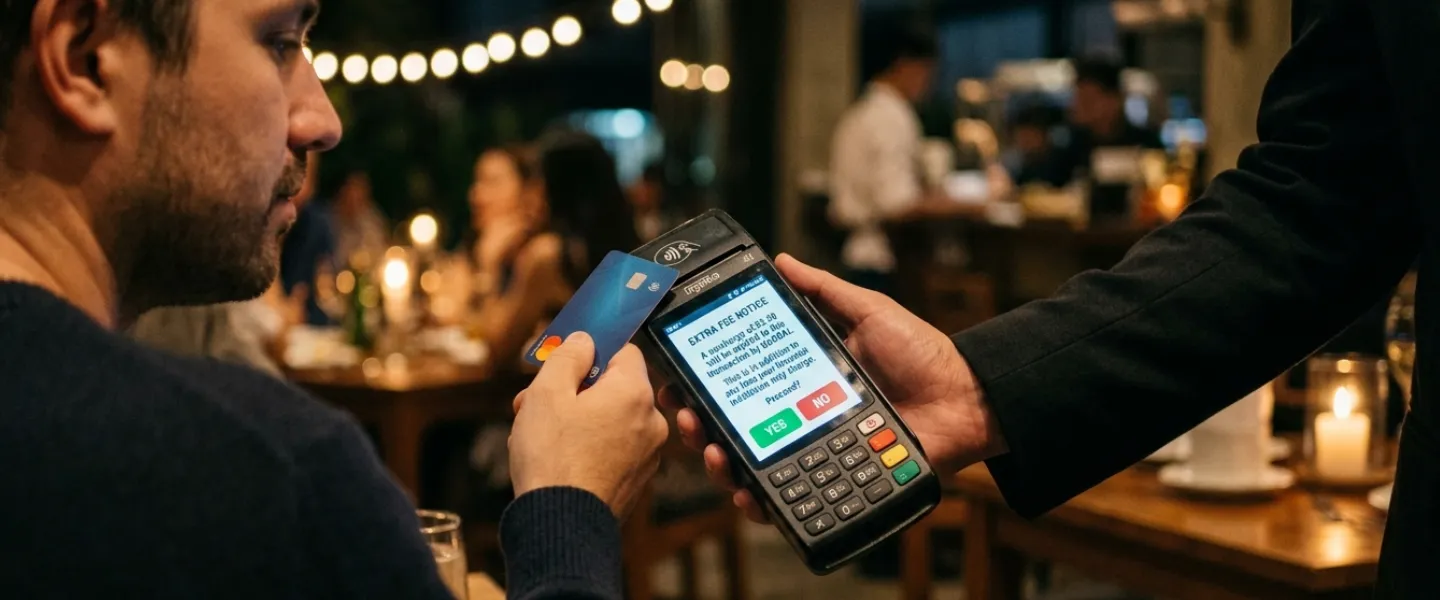
When a card machine or ATM asks "pay in your home currency?", say no. Every time.

This is one of the easiest ways to overpay abroad. At some point a card machine, a hotel checkout, or an ATM offers to charge you in your home currency instead of the local one. It looks helpful because the amount is shown in your own currency. In reality, it usually costs more.

That offer is dynamic currency conversion. Accept it and the merchant's bank sets the exchange rate, marked up by anywhere from 3% to 12%. A markup buried in the rate rather than charged as a fee is the same move most money transfer services make on the way out of the country, which we measured across eleven of them. Decline it and pay in the local currency, and the conversion runs through your card network, Visa or Mastercard, at a rate very close to the real one (your own bank may still add a fee on top, which Tip 2 covers). You're buying exactly the same thing either way. Paying local just skips the padded rate.

So whenever a screen offers you two amounts, one in the local currency and one in yours, pick the local one.
Where you'll see it
Restaurant or shop terminalChoose local currency
Hotel checkoutChoose local currency
Any ATMChoose local currency
A waiter holds out a card payment terminal to a diner at a restaurant, the screen prompting to confirm the charge.
When the machine offers to charge you in your home currency, say no.
2

Use the right travel card.

Some cards add up to 3% to every purchase abroad. A few add nothing. Know which one you're carrying before you leave.

Even when you pay in the local currency, your own card can still cost you. Some banks charge a foreign transaction fee on every purchase abroad, usually around 2.5% to 3%. There's no popup and no button to decline. It just shows up on your statement later.

Many travel cards and digital banks charge no foreign transaction fee, and the best also convert at the network rate without adding a markup of their own, so check for both, since a card can waive the fee and still shave the rate. Carry two cards from different providers. If one gets lost or blocked, the other keeps you going. If your card lets you top it up instantly from your phone, that's a useful bonus while traveling. Don't be fooled by rewards either: 1% cashback on a card with a 3% foreign fee still leaves you down 2% on every purchase.

Where you can, add the card to Apple Pay or Google Pay and pay with your phone. It works in many countries and keeps your physical card safely in your pocket until you need it.

Cash has its own trap: some credit cards treat a foreign ATM withdrawal as a cash advance and charge interest from the moment you press the button. So for withdrawals, use a debit card or a dedicated travel card and leave the rewards credit card for purchases.

Spend money in your destination

Compare travel cards on real spend: fees, ATM withdrawals, and FX markup.

USD
Include cash withdrawals
Off. Only card payments are included.
New to the calculator? Read what every line means, from the provider rate to ATM fees and cash back.
3

Avoid expensive ATMs.

One withdrawal can be charged three ways at once. Take out more, less often, from a real bank, and decline the conversion.

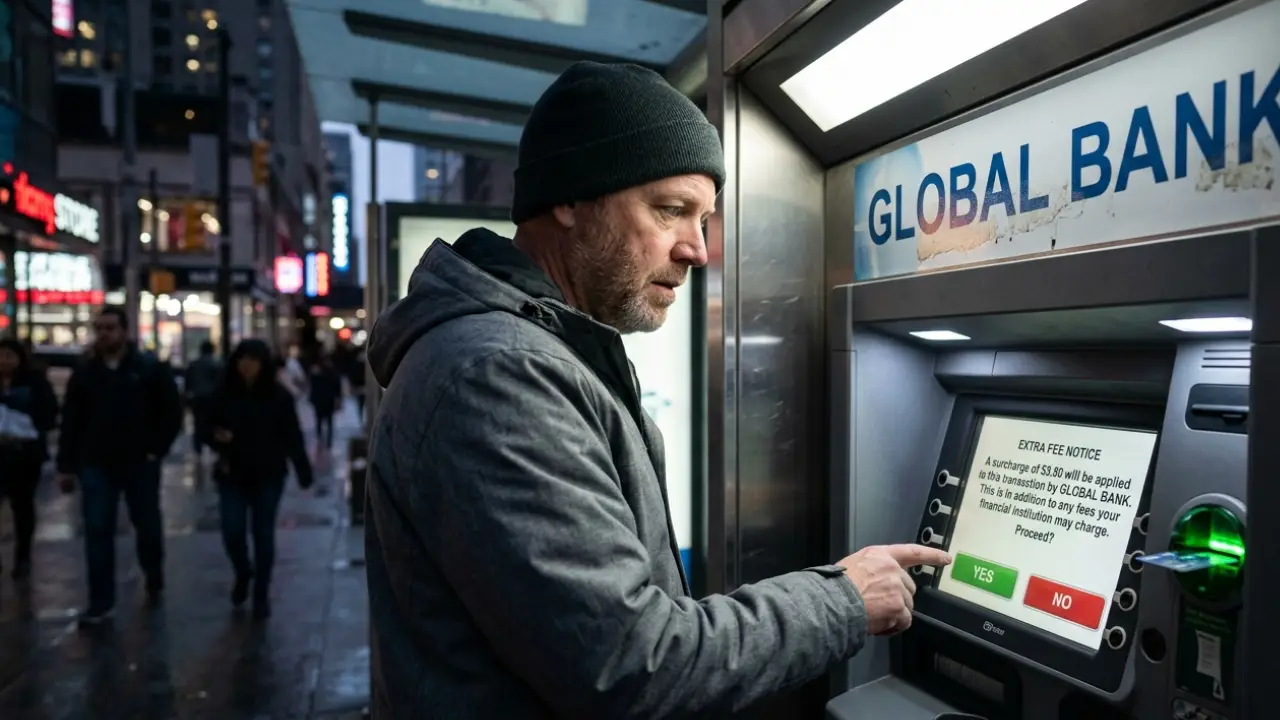
A foreign ATM can charge you three ways on a single withdrawal. First, the machine's own operator fee. These are usually highest at airports and tourist areas. Second, dynamic currency conversion again, the "convert to your home currency?" screen from Tip 1, which you decline. Third, your own bank's foreign-ATM fee, often a flat charge plus a small percentage.

Two of these fees are charged every time you withdraw cash, so taking out more at once usually works out cheaper. And use an ATM attached to a real bank branch rather than a standalone machine in a tourist area. The bright Euronet booths you see all over airports and old-town tourist strips are the ones to skip: notorious for a steep operator fee and a hard DCC sell.
The three fees, and how to dodge each
  • Operator fee use a bank-branch ATM, skip airport and standalone machines
  • DCC on the machine always decline "convert" and take the local currency
  • Your bank's fee fixed per withdrawal, so take out more, less often
  • Rule of thumb one larger withdrawal usually beats three small ones
A traveler at a street ATM facing an on-screen notice that the machine will add its own surcharge on top of whatever his own bank charges.
The machine adds its own surcharge, on top of whatever your bank charges.
4

Cash is sometimes still the best.

Card everywhere is a myth. Carry some local cash. How much depends on where you are.

In a few countries you can almost leave cash at home: Sweden, South Korea, and Singapore run on cards and phones. Plenty of others don't. Across much of Vietnam, Morocco, and Southeast Asia, markets, street food, taxis, small family-run places, and tips still prefer cash, and some spots that do take cards add a surcharge on top.

Card minimums are the other reason to carry some. Many shops won't run a card for a small purchase, so a coffee or a bottle of water needs coins in your pocket. Carry a modest amount of local cash for the cash economy, and use your card for anything bigger.

If you need cash, withdraw it from a bank ATM after you arrive instead of exchanging money at the airport. Airport exchange counters like Travelex are convenient, but they often offer some of the worst exchange rates you'll find. For how much cash a specific country actually needs, our destination guides cover the local money scene where you're headed.
Paying in your own currency is safer
No. It just lets the merchant set a padded rate. Pick local.
All cards charge the same abroad
No. Foreign fees run from 0% to over 3%.
Cashback covers the foreign fee
No. 1% back doesn't beat a 3% foreign transaction fee.
Airport exchange desks are fine
No. Among the worst rates you'll be offered anywhere.
Never carry cash abroad
No. Much of the world still runs on it.
My bank gives me a good exchange rate
Often not. Most high-street banks build a markup into the rate.

The 60-second wallet check before you fly

  • A fee-free card (no foreign transaction fee) is in my wallet
  • A backup card too, in case one gets blocked or eaten
  • I'll pick the local-currency amount on every terminal and ATM
  • ATM cash comes from a bank machine, in larger amounts, less often
  • A debit or travel card for withdrawals, not a rewards credit card
  • A little local cash for markets, taxis, tips and card minimums
  • No airport exchange desks, no home-bank "travel money" counter

Moving money to an account abroad

Everything above is about paying while you are there. Sending a lump sum to a local account is a separate job with its own pricing, and the markup usually sits in the exchange rate rather than the fee. We measured that across eleven services. These pages price one corridor at a time against a live rate.

Want more tips like these?

What to know about exchange rates, travel money, eSIMs, and scams, plus practical tricks that save you money wherever you go. Free, no spam.