
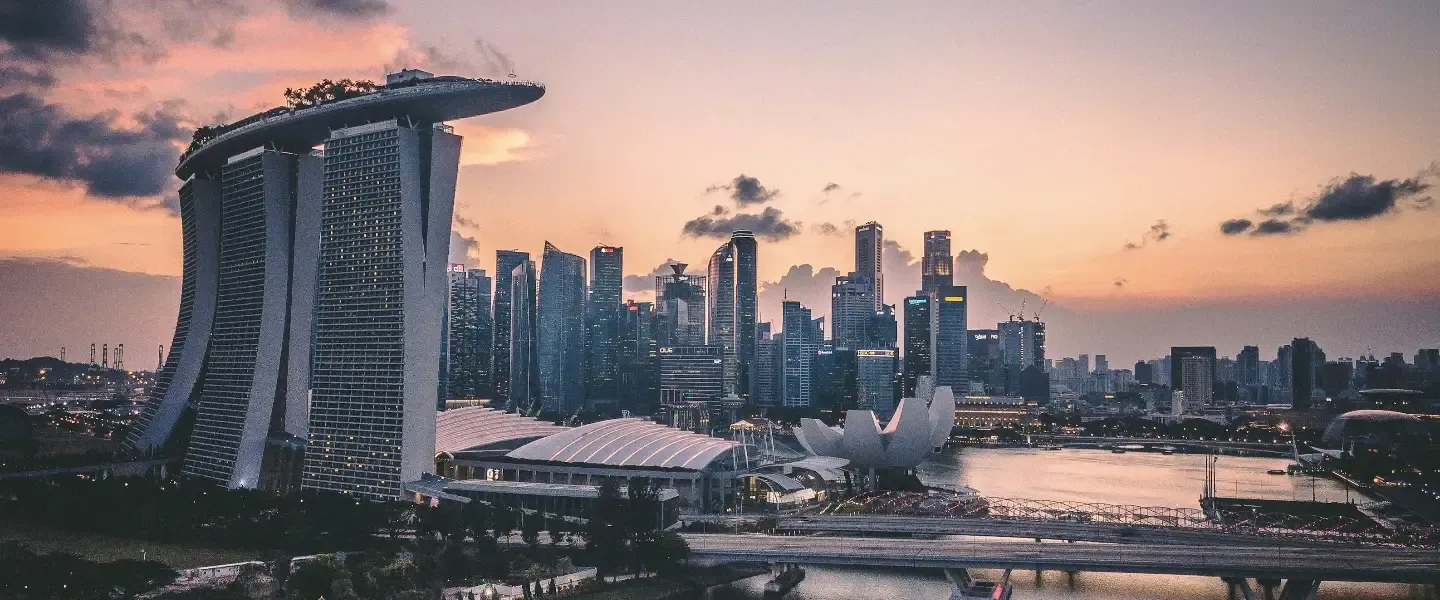
Singapore at a glance
- Tax system
How a country decides what it can tax you on. "Worldwide" means income you earn anywhere; "territorial" means only income earned inside the country; "remittance basis" means only the foreign income you actually bring into the country.
- Territorial
- Foreign income
- Exempt
- Top income-tax rate
- 24%
- Tax residency
- 183 days of presence or work in a calendar year make you a tax resident; holding an Employment Pass or PR does not by itself. Below that you are taxed as a non-resident, at a flat 24% (employment income at the higher of 15% or the resident rates).
- Capital gains
The profit you make when you sell something for more than you paid, like shares or property.
- None
- Dividends
- 0% (one-tier system; dividends are tax-free in your hands)
- Crypto
- No tax on a long-term holder's gains; frequent trading as a business, or crypto received as payment, is taxable income
- Permanent residency
- Permanent Resident, No fixed minimum; usually applied for after a year or two on an Employment Pass or S Pass
- Path to citizenship
- Eligible after 2 years as a PR; in practice most hold PR for 4-6 years first
- Dual citizenship
Whether you can keep your current passport after becoming a citizen here. "Conditional" means it is limited or not guaranteed: allowed only in certain cases, or tolerated in practice but not written into law.
- No (you must give up your current citizenship)
- Foreign property
- Condos only
- Reports to your home country (CRS)
Under the Common Reporting Standard, tax authorities in participating countries automatically share information about each other's residents' bank accounts.
- Yes
Income tax for residents
| Annual taxable income | Rate |
|---|---|
| Up to SGD 20K | 0% |
| SGD 20K to SGD 30K | 2% |
| SGD 30K to SGD 40K | 3.5% |
| SGD 40K to SGD 80K | 7% |
| SGD 80K to SGD 120K | 11.5% |
| SGD 120K to SGD 160K | 15% |
| SGD 160K to SGD 200K | 18% |
| SGD 200K to SGD 240K | 19% |
| SGD 240K to SGD 280K | 19.5% |
| SGD 280K to SGD 320K | 20% |
| SGD 320K to SGD 500K | 22% |
| SGD 500K to SGD 1M | 23% |
| Over SGD 1M | 24% |
The first SGD 20,000 is tax-free and the top 24% rate only starts above SGD 1,000,000. There is no state or municipal income tax on top. Non-residents pay a flat 24%.
Sources: tax · immigration
Singapore tax calculator
Singapore taxes residents on local income and leaves foreign income alone, so this estimates the tax on your Singapore earnings. The first SGD 20,000 is tax-free, and the rates climb gently from there.
Money you earn from work or business done inside Singapore. Income earned where you live is almost always taxable there, so it feeds the brackets in full.
Foreigners are taxed only on income earned inside Singapore, so money you earn abroad is not taxed here. Enter it if you like: you will see it does not add anything to the bill, however large it gets.
Left out of the tax: Singapore taxes foreigners only on income earned here, so this stays untaxed no matter the amount.
A rough guide only. It applies the resident rates to Singapore-source income and treats foreign income as exempt, which is the rule for individuals. It ignores personal reliefs (earned-income, spouse, child and others), CPF, and the trading-versus-investment test. Confirm your own numbers with a tax adviser.
Tax rates from PwC Worldwide Tax Summaries.
Sending money to Singapore
A deposit, an agent's fee and the first months of rent tend to fall due before your local account is open, and in Singapore those numbers are large. Getting money in at a good rate matters from the start.
On a deposit that size the gap between services is worth checking. Compare them on how much reaches the account in Singapore dollars rather than the rate on the quote, and our guide to money in Singapore goes deeper.
Cost of sending money to Singapore


Compare Providers









What living in Singapore is like
Day to day, Singapore feels almost frictionless: clean, safe, green for a city this dense, and everything from the trains to the hospitals just works. The number it cannot paper over is the cost of living, the highest in the region by a wide margin. Each score is out of 100 and compared with the other countries on RoamFX; tap the info icon on any row for the reasoning.
Where foreigners live in Singapore
Singapore is a single city, so this is about neighborhoods, not towns. Where you land tends to track your budget and whether you have children, and a central two-bedroom costs somewhere between SGD 5,000 and 9,000 a month.
- Orchard & River Valley Senior expats · finance
Central and priciest, from the malls on Orchard Road to the bars along Robertson Quay. The default for well-paid singles and couples who want to walk to work, at roughly SGD 6,000 to 9,000 for a two-bedroom.
- Holland Village & Bukit Timah Expat families
Low-rise and green, and where the big international schools sit (Tanglin Trust, the UWC campus). Families cluster here for the short school run more than the nightlife.
- East Coast & Katong Younger families · better value
Along the coast by East Coast Park, with the Peranakan shophouses and food of Joo Chiat Road. More space for the money than the center.
- Tanjong Pagar & the CBD fringe Young professionals
In the thick of it, a short walk to the office towers, with the bars and restaurants of Tanjong Pagar and Duxton Hill on the doorstep.
- Sentosa Cove The wealthy
The one enclave where foreigners can buy a landed, waterfront home, on a resort island off the south coast. A world of its own, and priced like it.
Is Singapore right for you?
A good fit for
- Skilled professionals and executives, especially in finance and tech
- Families who want safety, top schools and things that work
- The globally mobile wealthy who value stability over cost
Probably not for
- Retirees: there is no retirement visa
- Budget travelers and nomads chasing cheap rent
- Anyone who wants to own a house and the land under it
Before you move to Singapore
The practical things people look up before a move.
- Healthcare
- Excellent, insure privately Among the best anywhere. MediSave and MediShield Life cover citizens and PRs; expats on work passes are not, and rely on private insurance, usually through an employer. Buying your own starts at about SGD 2,000 a year and gets much more expensive with age.
- Banking
- Easy for pass holders DBS, OCBC, UOB and the international banks open accounts with a passport, pass and proof of address, often within a day or two.
- Driving
- Convertible, but owning is brutal You can convert a foreign license, but a Certificate of Entitlement to own a car costs over SGD 100,000 on its own. Most residents skip it and use the MRT, where a monthly pass is about SGD 130.
- Schooling
- Excellent, competitive, costly Strong international schools, but places are competitive and fees are high. Local public schools prioritise citizens, then PRs, then foreigners.
- English
- Official language Universal. Work, school, government and daily life all run in English.
- Internet
- Among the fastest anywhere Near-universal gigabit fibre, cheap and standard.
- Electricity
- 230V, UK-style plugs Type G three-pin plugs, extremely reliable supply.
- Pets
- Possible, with rules Import needs permits, microchip and vaccination, and quarantine for some origins. HDB flats restrict dog breeds and numbers; condos set their own rules.
- Mobile phone
- SIM easy Cheap, competitive prepaid and eSIM plans from Singtel, StarHub and M1. Set up on arrival with a passport.
- Getting there
- A top global hub Changi connects to almost everywhere, and it is one of the best airports in the world to pass through.
- Currency
- Singapore dollar, very stable Managed by the central bank against an undisclosed basket, so it stays steady. Not a hard peg to the US dollar.
- Bringing your things
- Personal effects OK Used household goods generally come in free of duty and GST within the relocation window.
- Importing a car
- Don't Between the COE and the duties, importing a car is among the most expensive things you could do here. Buy locally or, better, don't buy at all.
Common mistakes when moving to Singapore
-
MythSingapore taxes your worldwide income.
RealityNot for individuals. Foreign income you bring in is exempt, so the low-tax reputation is real. What catches people out is the cost of living.
-
MythAn Employment Pass or PR makes you a tax resident.
RealityNo. Tax residency turns on spending 183 days here in a year, not on which pass you hold.
-
MythForeigners cannot buy property.
RealityYou can buy a condo. You just pay a 60% additional stamp duty on top, which changes the sums a lot.
-
MythYou will need a car.
RealityYou very much will not. A permit to own one, the COE, costs well over SGD 100,000 by itself, and the MRT is fast and cheap.
-
MythA job offer means PR is a formality.
RealityIt is not. You can apply after a year or two on a pass, but the criteria are unpublished and approval is selective, and plenty of long-term pass holders are turned down.
Can you actually move to Singapore?
Only through a handful of routes, and each has a bar to clear. There is no general residence permit and no way to move over just because you want to. We cover the detail in our Singapore visa guide; the usual ways in are:
- Employment Pass, for professionals earning at least SGD 5,600 a month (more in finance, and more with age), sponsored by an employer and scored on the COMPASS framework.
- S Pass, for mid-skilled staff on at least SGD 3,300 a month, subject to an employer quota and levy.
- ONE Pass, a five-year, employer-agnostic pass for top earners on SGD 30,000 a month or standouts in their field.
- EntrePass, for founders building a funded or innovative company here.
- Permanent Residence, usually applied for after a year or two on an Employment Pass or S Pass, or through the Global Investor Programme for those putting in from SGD 10 million.
- Family passes, a Long-Term Visit Pass for the spouse, child or parent of a citizen, PR or eligible pass holder.
There is no retirement or nomad visa
Singapore has no retirement visa and no digital-nomad visa, and working remotely for an overseas employer on a tourist entry is not allowed. If you are retired, your realistic options are an employer-sponsored pass (which most retirees will not get), the Global Investor Programme (if you are wealthy enough), or a family pass sponsored by a Singaporean child.
Plenty of people love the idea of retiring to a safe, English-speaking, well-run city in Asia. Singapore is that city, and it offers no way to do it. Malaysia's MM2H programme next door is where people usually end up looking instead.
The residency ladder: work pass to PR to citizenship
Most people start on a work pass, then apply for Permanent Residence once they have a track record here. Approval is far from automatic: the criteria are unpublished, and a strong CV and steady local income count for a lot. PR, once you have it, lets you change jobs freely, buy a resale HDB flat with a spouse, and stop worrying about pass renewals. You keep it with a Re-Entry Permit, usually valid five years and renewed on your ties and contribution; there is no fixed days-per-year rule, but weak local ties hurt at renewal.
Citizenship comes after that. You can apply once you have held PR for two years, though in practice most successful applicants have held it four to six years or more. Adults complete the Singapore Citizenship Journey, a set of online modules and a community component, rather than a written exam.
The catch sits at the top of the ladder: Singapore does not allow dual citizenship. Becoming a citizen means giving up the passport you already hold, which is why many long-term PRs stop at residency and never take the last step.
How Singapore taxes you once you live there
Singapore is light on personal tax, and the reason people move here for it. Resident rates are progressive from 0% to a top of 24%, and that 24% only bites above SGD 1,000,000 of income. There is no capital gains tax, so gains on shares, property and crypto are normally untaxed, and dividends reach you tax-free under the one-tier system. There is no wealth tax, and estate duty was abolished in 2008.
For foreign income the answer is better still. Singapore is effectively territorial for individuals. Foreign-source income received by a resident is exempt, with one narrow exception: income earned through a Singapore partnership. So a foreign salary, foreign dividends or a foreign pension brought into the country are generally not taxed here. Tax residency itself is a pure day count, 183 days of presence or work in a calendar year, and it does not turn on your pass. Below that you are taxed as a non-resident at a flat 24%.
Two caveats keep it honest. If the tax office decides you are trading rather than investing, those gains can be treated as ordinary income, and the same logic applies to frequent crypto trading. And Singapore takes part in the Common Reporting Standard, so your home tax authority and Singapore can exchange account information. The old Not Ordinarily Resident concession is gone, closed to new entrants, so do not plan around it.
The cost of living
Singapore is consistently one of the most expensive cities in the world, and housing is the line that hurts. Rents ran up hard between 2022 and 2024 and have stayed high. A one-bedroom condo in a central area costs about SGD 3,500 to 5,000 a month; a family-sized three-bedroom in Orchard or River Valley can clear SGD 10,000.
The rest follows from the rent. A hawker meal is still SGD 5 or 6 and the MRT is cheap, so a modest life is genuinely doable. Push past that and it bites: a beer in a bar is around SGD 15, a cocktail closer to SGD 25, international-school fees reach the tens of thousands a year, and owning a car is a six-figure decision before you have driven anywhere. Our guide to money in Singapore gets into the day-to-day numbers. The low tax rate is real, and for most people it does not come close to covering what the rent costs.
Renting vs buying in Singapore
Almost everyone rents. Foreigners can buy a condo, but the 60% stamp duty (below) makes it a very large bet on staying, so renting is the default even for people who own homes elsewhere.
The rental market is formal and tightly regulated, so there is little of the scam risk you get elsewhere in the region. Agents must be licensed by the Council for Estate Agencies (CEA), tenancy agreements follow a standard template, and your deposit is held against a documented inventory rather than a landlord's goodwill. After the 2022 to 2024 run-up, rents have come off the peak, so modest negotiation is realistic again, often in the region of 3 to 5% on a fair asking price.
Leases are one or two years. The security deposit is one month's rent for each year of the lease, so two months on a two-year lease, paid with the first month up front. A clean handover gets it back within about two weeks. If an agent represents you, their fee is commonly around one month's rent on a one-year lease, and often waived on a two-year lease where the landlord's agent takes the commission. A whole condo or HDB flat is the family option; a single room in an HDB flat is how many singles keep the cost down.
Read the maintenance clauses before signing, because Singapore has its own conventions. Tenants are usually liable for minor repairs up to a set figure per item, typically SGD 150 to 250. The landlord covers anything above that, and quarterly air-conditioning servicing falls on the tenant too, at a few hundred dollars a year.
Buying is the harder call. You can buy a private condominium without government approval, but a foreigner pays an Additional Buyer's Stamp Duty of 60% on top of the standard duty, so on a SGD 2 million condo that is SGD 1.2 million in ABSD alone. US nationals, and nationals or PRs of a few countries with trade agreements, are treated as citizens and can skip the surcharge on a first home, so check your own status. A Singapore bank will lend a foreigner up to about 75% of the price on a first property, but with no access to CPF the whole down payment and every monthly repayment come out of cash. Landed houses need government approval and are mostly off-limits, the one exception being leasehold homes on Sentosa Cove; public HDB flats are closed to foreigners entirely.
The market is online and agent-led:
- Property portals. PropertyGuru, 99.co and SRX carry almost the whole market, in English and with reliable asking prices. Rents by area are in the cost-of-living section above.
- Agents. Every agent must be CEA-licensed; check the name on the public register before you deal with them. Using one is standard and low-risk.
- Rooms and flatshares. For a single room, the portals' room listings and the usual chat groups hold the cheaper options; meet the tenant or owner and see the room before paying.
Bringing your belongings over
Bringing your life over is easy by regional standards. Used personal effects generally come in free of duty and GST within the relocation window, and sea-freight moves are routine. The one thing not to ship is a car: between the Certificate of Entitlement and the duties, owning a vehicle here is among the most expensive in the world, and almost everyone relies on the trains and buses instead.
Moving to Singapore with kids
Most families who move to Singapore use international schools, and not always by choice. Government schools give priority to citizens and permanent residents. A foreign child joining above Primary 1 has to sit an entrance exam, the AEIS, and a place is not guaranteed. Published primary fees run from about SGD 22,000 to SGD 50,000 a year. Middleton International and One World International sit at the affordable end. UWCSEA, Tanglin Trust, Stamford American and the Singapore American School are all near the top. Every published figure includes 9% GST.
Some things to keep in mind. A government place, if you get one, costs SGD 1,035 a month for a non-ASEAN foreign child, less than half the cheapest international school. One-time fees are high and none of them come back. Tanglin Trust charges SGD 10,000 across application, enrollment and a capital levy. The Singapore American School asks up to SGD 12,400 before the first day. UWCSEA adds a development levy every year on top of tuition.
Last checked on: August 2026
Last checked on: August 2026
Fees vary by school. See the schools and more living costs on the Singapore cost of living page.
Bottom line
For a skilled worker or someone with real capital, Singapore is close to the best-run place you could move to: safe, efficient, excellent on healthcare and schools, and light on tax. None of that is in doubt. The bill arrives as rent, and it is large enough that the tax savings rarely cover it.
Come with an employer or a business and the numbers add up. Come hoping to retire on a nomad budget and there is no door: no retirement visa, no nomad visa, and a one-bedroom that costs more than a whole house would in most of the region.
This guide is based on public information and is not legal, tax or immigration advice. Rules change, so always confirm anything important with a qualified professional.
Living in Singapore?
Get our guides before you go: the visa rules that keep changing, the tax traps, and what living somewhere costs.
Frequently Asked Questions
-
Does Singapore tax my foreign income?
Generally no. Singapore is effectively territorial for individuals: foreign-source income received by a resident is exempt, with the one narrow exception of income earned through a Singapore partnership. So a foreign salary, foreign dividends or a foreign pension brought in are normally untaxed here. Your home country may still tax you, so check both sides with an adviser.
-
Is there a retirement visa or a digital-nomad visa for Singapore?
No, to both. Singapore has no retirement visa and no digital-nomad visa, and working remotely for an overseas employer on a tourist entry is not allowed. Retirees generally need an employer-sponsored pass, the wealth-based Global Investor Programme, or a family pass sponsored by a Singaporean child.
-
When do I become a Singapore tax resident?
When you are present or employed in Singapore for 183 days or more in a calendar year. It is a day count, not a matter of which pass you hold: an Employment Pass or PR does not by itself make you tax-resident, and below 183 days you are taxed as a non-resident at a flat 24%.
-
Can foreigners buy property in Singapore?
Yes, private condominiums, but foreigners pay a 60% Additional Buyer's Stamp Duty on top of the standard duty, which changes the math significantly. Landed houses need government approval and are mostly off-limits, apart from leasehold homes in Sentosa Cove. US nationals and a few others are treated as citizens for ABSD under trade agreements.
-
Can I keep my current passport if I become Singaporean?
No. Singapore does not allow dual citizenship for adults. Becoming a citizen requires giving up your existing nationality, which is the main reason many long-term permanent residents never apply for citizenship.