
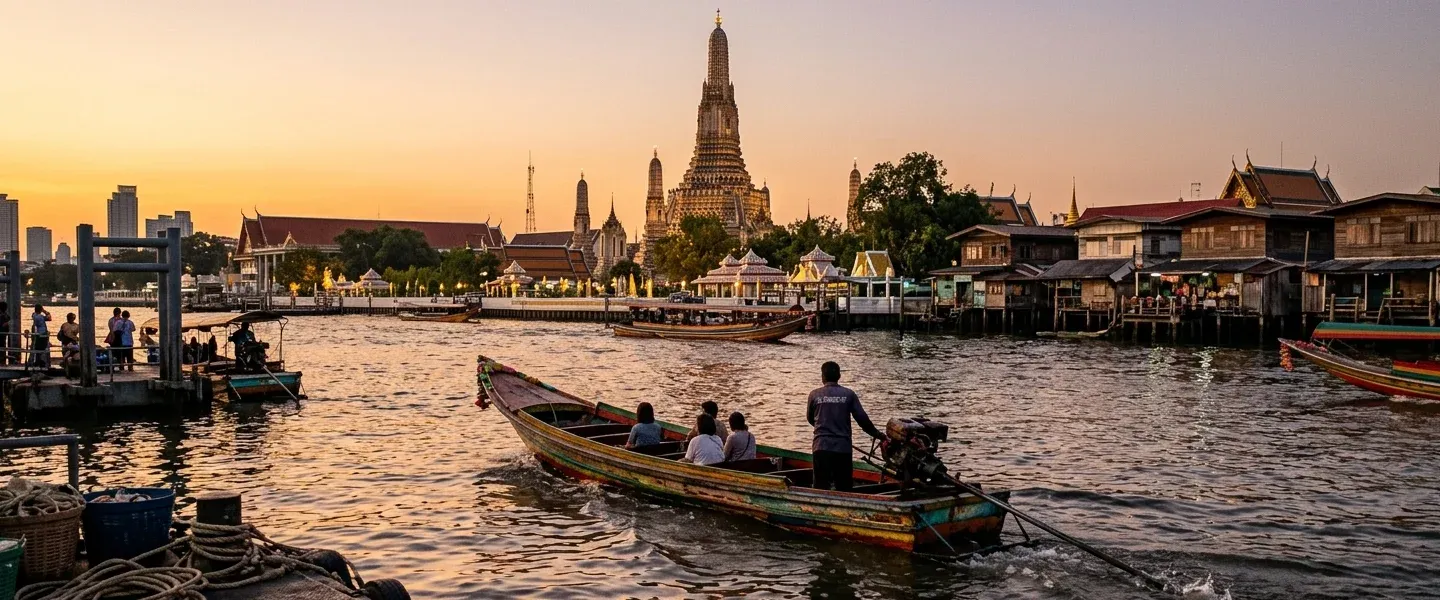
Currency in Thailand: Thai Baht (THB)
Thailand's currency is the baht (THB), written ฿ and split into 100 satang you'll almost never handle. By law it's what you pay in. A few hotels and tour desks quote US dollars, but you settle in baht at a rate they set, which is usually worse than paying in baht from the start. Get your baht from an ATM or a money changer once you land.
Notes come in ฿20, ฿50, ฿100, ฿500 and ฿1,000, with coins in ฿1, ฿2, ฿5 and ฿10. The ฿1,000 is the biggest note and the one ATMs mostly dispense, so you'll often need to break it. Keep a stash of ฿20, ฿50 and ฿100 notes, because street vendors, songthaew drivers and market stalls frequently can't change a ฿1,000.
So what does that buy you? US dollars are worth about ฿33.60 each today, and the baht has traded between ฿31.00 and ฿33.83 to the dollar over the past year. The card below shows whether now is a good time to convert into baht, and the chart tracks how the dollar has held up against it over the past five years.
So ฿100 is about $2.98, and ฿1,000 is $29.77.
- US Dollar USD
- Euro EUR
- British Pound GBP
- Australian Dollar AUD
- Canadian Dollar CAD
- New Zealand Dollar NZD
- Swiss Franc CHF
- Singapore Dollar SGD
- Hong Kong Dollar HKD
- Japanese Yen JPY
- Chinese Yuan CNY
- Indian Rupee INR
- Indonesian Rupiah IDR
- Malaysian Ringgit MYR
- Philippine Peso PHP
- South Korean Won KRW
- South African Rand ZAR
- Mexican Peso MXN
- Brazilian Real BRL
- Turkish Lira TRY
- Israeli Shekel ILS
- Polish Zloty PLN
- Czech Koruna CZK
- Hungarian Forint HUF
- Romanian Leu RON
- Swedish Krona SEK
- Norwegian Krone NOK
- Danish Krone DKK
- Icelandic Krona ISK




























Good time to convert.
The baht is near the weakest it has been all year against the dollar, so your money goes further than usual. Twelve-month average: ฿32.43.
Paying with card in Thailand
In the cities your card handles the big stuff. Visa and Mastercard are taken across hotels, malls, supermarkets, chain cafés and mid-range and upmarket restaurants in Bangkok, Chiang Mai, Phuket and the like. UnionPay is widely accepted too, thanks to the many Chinese visitors, while American Express is patchier, so don't make Amex your only card. Step off the tourist grid, into street food, wet markets, songthaews, small guesthouses and rural shops, and it's cash or QR only. Both debit and credit cards work anywhere Visa or Mastercard is: a debit card is what you'll lean on at ATMs, while a credit card usually adds better purchase protection and, on the right travel card, no foreign-transaction fee.
Where you'll meet friction is the surcharge. Some smaller shops, tour desks and guesthouses add 2 to 3% for paying by card, most often on Amex and foreign cards, to cover the processing fee. It's legal here and rarely worth an argument, so keep enough cash for those places and put everything else on the card. Separately, your own bank may charge a foreign-transaction fee on every payment abroad, which is exactly what the calculator below helps you dodge with the right card.
Contactless is worth using where the terminal takes it. Wherever a reader accepts tap-to-pay, Apple Pay and Google Pay work too if they're linked to a Visa or Mastercard, with your phone handing over a one-time token instead of your real card number. Coverage is good in malls, hotels, airports and chains, thinner at small vendors, and Bangkok's MRT and Airport Rail Link now take contactless bank cards straight at the gate.
Always pay in baht. At any ATM or card machine, decline the offer to "convert" or charge you in your home currency. Paying in THB lets your card set the exchange rate, which almost always beats the terminal's by a few percent.
Compare travel cards on how you actually spend
Free travel cards available
New to comparing cards? See how the calculator works.
Cash in Thailand
You don't need a brick of cash, but you do need some every day. Cards and QR cover hotels and bigger restaurants; cash is for street food, markets, songthaews, tuk-tuks, tips, temple donations and anywhere rural or island. Around ฿1,000 to ฿3,000 on you is a sensible float, more if you're heading somewhere without ATMs. When you withdraw, take a large amount in one go, because every Thai ATM charges a flat fee per foreign-card withdrawal, and pulling more, less often, is the single biggest way to keep that cost down.
- Keep small notes. Vendors, drivers and stalls often can't break a ฿1,000, so hold on to your ฿20, ฿50 and ฿100 notes for everyday spending.
- Withdraw the maximum, not a little at a time. The Thai ATM fee is flat per withdrawal, so one ฿20,000 to ฿30,000 pull costs the same fee as a ฿2,000 one. Fewer, bigger withdrawals spread that ฿220 thin.
- Let Grab carry your small spending. Add a foreign Visa or Mastercard to the Grab app and it pays for rides and food delivery in-app, so a chunk of daily spending never needs a baht note. The local wallets (TrueMoney, and PromptPay itself) generally need a Thai bank account or SIM, so they're rarely an option on a short trip.
- Break big notes where change is easy. 7-Eleven, Big C, Lotus's and hotels are the painless places to split a ฿1,000 into usable notes.
- Change a little on arrival, the rest in town. A taxi from the airport and your first meal go smoother with cash in hand, so change a small amount at the airport (ideally at the SuperRich counter there, not the arrivals booths) and do the rest at a city changer or ATM.
Best ATMs in Thailand (fees by bank)
Thailand's ATMs belong to its banks, and here they nearly all do the same thing: add a flat fee to every foreign-card withdrawal. That fee, not the exchange rate, is what quietly adds up over a trip. What follows is the local machine's fee only; your own bank may add its own foreign-ATM fee back home.
Three separate charges can land on one withdrawal, and it's easy to blur them: the local ATM fee added by the Thai machine (the table below), your own bank's foreign-ATM fee charged at home, and DCC, where the screen offers to bill you in your home currency at a poor rate. Decline DCC every time. The table below is the local fee only.
Use ATMs at a bank branch, mall or 7-Eleven, not lone machines down a quiet street. It isn't only about fees. A machine attached to a bank branch, inside a mall or in a busy 7-Eleven is better watched and a less attractive target for skimming than a standalone one down a quiet street. Cover the keypad as you type your PIN, and if the card slot looks loose or bulky, walk away. For the lowest fee, look for an AEON ATM (inside many Big C, Lotus's and Makro stores): at ฿150 it's the cheapest around, though no longer free.
- Charges a per-withdrawal fee
- AEON ฿150 The cheapest fee when you find one, but the network has shrunk and some machines now refuse foreign cards. Worth trying inside Big C, Lotus's and Makro, not worth a detour.
- Bangkok Bank ฿220 Reliable and everywhere; the ฿220 flat fee and a higher-than-usual cap of about ฿25,000.
- Kasikorn (KBank) ฿220 The ฿220 flat fee and a typical ฿20,000 to ฿25,000 per-withdrawal cap.
- SCB & Krungthai (KTB) ฿220 Huge networks; the same ฿220 fee and a standard ~฿20,000 cap.
- Krungsri (yellow) ฿250 Visa, ฿350 Mastercard Raised its foreign-card fee in March 2026 and now charges by card network. Still the highest single withdrawal at about ฿30,000, so bring a Visa and pull the maximum.
- Fee not published
- ttb (TMBThanachart) Not confirmed Widely available and reported to allow about ฿30,000 in one go. Read the fee on screen, since we have not confirmed it.
- UOB & Government Savings Bank Not confirmed Both take foreign cards and both are easy to find. UOB absorbed the old Citibank machines, so look for it if you remember those.
- Standalone street ATMs ฿220+ Most likely to push currency conversion and where skimming shows up. Use a machine at a bank branch, mall or 7-Eleven instead.
- Budget ฿220 to ฿250 per withdrawal, and more on a Mastercard. ฿220 was the flat rate across Bangkok Bank, Kasikorn, SCB, Krungsri, Krungthai and ttb for years, but it started moving in 2026. Krungsri now charges by card network, and travelers have been billed ฿350 on a Mastercard there and at SCB. Read the on-screen amount every time, and carry a Visa if you have the choice.
- AEON is the cheapest, at ฿150. It used to be free and no longer is, but it still undercuts the ฿220 banks. You'll find AEON machines inside many Big C, Lotus's and Makro stores.
- Withdraw the maximum to pay the fee less often. Most machines cap you at ฿20,000 per withdrawal, but Bangkok Bank goes to about ฿25,000 and Krungsri (the yellow bank) up to ฿30,000. Your home bank's daily limit may still cap you, so plan for more than one pull on a big cash day. If a withdrawal is declined outright, it's usually that home-bank limit or a card-network security block, not the Thai machine refusing you.
- Your own travel card may cap free withdrawals too. Cards like Wise and Revolut give a set amount of fee-free ATM withdrawals each month, then add their own percentage on top. The flat Thai fee stays the same either way, but it explains why a late-trip withdrawal can quietly cost more.
- Wait for the card, not just the cash. Some machines return the notes first, so don't walk off until your card is back in your hand.
- Read the on-screen fee before you confirm. Amounts have been rising and vary by bank and card, so check the prompt rather than assume.
Updated September 2026
Exchanging cash in Thailand
If you've brought cash from home or want to change a larger sum at once, Use a proper money changer rather than a bank, a hotel desk or the airport arrivals counter. The gap between the best and worst rates can be 3 to 5%, which on a few hundred dollars is real money. Two things decide whether you get a fair deal: where you change, and the notes you bring.
- Use a dedicated money changer, not a bank or hotel. In Bangkok the best-known are SuperRich (the green company on Rajdamri and the separate orange one), Vasu on Sukhumvit Soi 7/1, and Twelve Victory, all within a fraction of a percent of the mid-market rate. Chiang Mai, Phuket and the other tourist centers have their own well-known changers; the bank booths in the airport arrivals hall are the ones to avoid.
- At the airport, change enough for your first taxi and meal, or find the SuperRich counter. The bank booths in the Suvarnabhumi arrivals hall post noticeably worse rates than the city changers. SuperRich has its own counter down on Floor B, at the Airport Rail Link level, with rates much closer to its city branches, so change a little at arrivals and do the rest there or in town.
- Bring clean, large US dollars. New, unmarked USD $100 and $50 notes get a noticeably better rate than small bills or the equivalent in other currencies; torn, marked or written-on notes get a worse rate or are refused.
- Compare the posted rate, it's shown openly. Thai changers display their buy and sell rates on boards and apps, so it's easy to check who's best before you hand anything over. There's little of the counting trickery you meet elsewhere, but count your baht before you leave anyway.
- Change back before you fly. Leftover baht is easy to reconvert at the same changers, though you lose a little on the spread, so change back only what you won't spend.
For everyday spending an ATM is simpler and the effective rate is close, so save the money changer for larger cash sums or for turning home-currency notes into baht.
Paying by QR (PromptPay) in Thailand
Locals pay for almost everything by scanning a PromptPay QR code, Thailand's national real-time payment system, and it's now the default at restaurants, 7-Elevens, markets, taxis and attractions. For foreign visitors, though, it's the one payment method that mostly doesn't work directly, because native PromptPay needs a Thai bank account.
- From Singapore, Malaysia, Indonesia, Vietnam, Cambodia, Laos, Hong Kong or Japan: if you bank in one of these, your home banking or e-wallet app may already scan Thai PromptPay codes through a cross-border link, billed in your own currency, and India is being connected too. These links are country-specific, though, and don't help a general Western visitor.
- From the US, UK, EU or Australia: there's no direct way to pay PromptPay without a Thai account. The workarounds that do function are Alipay topped up with a Visa or Mastercard (it scans Thai QR at chains, but the exchange rate runs a couple of percent worse), or a tourist-focused app like Moreta Pay that pays over the Thai QR network from your home bank. TrueMoney, the local wallet, needs a Thai SIM and can't be topped up with a foreign card, so it's marginal for a short trip.
A growing number of small cafés and local restaurants now display only a PromptPay QR code, but if you can't scan it they'll almost always take cash instead. For a normal holiday it's not worth chasing the workarounds: a contactless Visa or Mastercard plus some cash already covers everywhere PromptPay does.
VAT refund for tourists in Thailand
Thailand charges 7% VAT, and visitors can claim it back on goods bought at shops that show the "VAT Refund for Tourists" sign. The shop doesn't give you the money: it gives you a form, and you collect the refund at the airport when you leave. After a small handling fee, you get back roughly 4 to 6% of what you spent.
- Spend at least 2,000 baht in one shop on one day, and ask for form P.P.10 with the original tax invoices. You need your passport to get it.
- Leave by air within 60 days of the purchase. You can't claim if you have stayed in Thailand more than 180 days, and services such as hotels and restaurants don't qualify.
- Show the goods to customs before you check in if the total is 20,000 baht or more. Then collect the refund at the VAT refund office after immigration, where expensive items may be checked again.
- Refunds up to 30,000 baht can be paid in cash. Larger refunds go by bank draft or to a credit card.
- Claim at one of ten airports, including Suvarnabhumi, Don Mueang, Phuket, Chiang Mai, Krabi and Samui.
Leave extra time at the airport: the customs desk and the refund office can both have lines, and the refund can't be claimed once you have boarded.
Sending money to Thailand
Most visitors never need this. But if you're paying a hotel or villa deposit, sending money to family, or funding a longer stay, the rate you're quoted is rarely the rate you get. Most of the cost isn't the visible fee. It's a markup buried in the exchange rate, often a few percent you never see itemized.
The mid-market rate is the real mid-point you'd see on Google, and it's the benchmark a fair transfer should track. Specialist services like Wise and Instarem land within about 1% of it and pay out in baht straight to the main Thai banks (Bangkok Bank, Kasikorn and SCB), usually within a day. A high-street bank wire can quietly cost several percent once the rate markup and correspondent-bank fees are counted, and it takes longer.
The exchange rate matters more than the advertised fee. A provider can advertise "zero fees" and still cost you the most if its exchange rate sits a few percent under mid-market. Compare the final baht that arrives, not the headline fee.
See what you'll actually receive today
Compare Providers









Travel tips?
Sign up for our guide on how to save money on your next trip.
Frequently Asked Questions
-
Which ATM in Thailand has the lowest fees?
AEON, at ฿150 per withdrawal, is the cheapest, and you'll find its machines inside many Big C, Lotus's and Makro stores. Every major Thai bank (Bangkok Bank, Kasikorn, SCB, Krungsri and the rest) charges a flat fee of about ฿220 on foreign cards, on top of your own bank's fee. Whichever you use, withdraw the maximum in one go and always choose to be charged in baht, not your home currency.
-
How much is the ATM fee in Thailand?
Reckon on ฿220 to ฿250, and up to ฿350 on a Mastercard. ฿220 held across the major banks for years and started rising in 2026: Krungsri now charges by card network, and ฿350 has been billed on Mastercard withdrawals there and at SCB. AEON is cheaper at ฿150 where you can still find a machine that takes your card. It's a flat fee per withdrawal, so take the maximum each time, ฿20,000 to ฿30,000 depending on the bank.
-
How much cash should I carry in Thailand?
Enough for the day's small spending, roughly ฿1,000 to ฿3,000, and more if you're heading to islands or rural areas where ATMs thin out. Cards and QR cover hotels and bigger restaurants, so cash is mainly for street food, markets, songthaews, tuk-tuks and tips. Keep small notes, as vendors often can't break a ฿1,000.
-
Can tourists use PromptPay in Thailand?
Usually not directly. PromptPay is what locals pay with, but it needs a Thai bank account, and the local wallet TrueMoney needs a Thai SIM. Unless you bank in a linked country (such as Singapore, Malaysia or Japan) and can use a cross-border QR link, stick to a contactless card and cash, which cover everywhere PromptPay does. Alipay topped up with a foreign card is the main workaround, at a slightly worse rate.
-
Where's the best place to change money in Thailand?
A dedicated money changer, not a bank, hotel or the airport arrivals hall. In Bangkok, SuperRich (green and orange), Vasu and Twelve Victory give rates within a fraction of a percent of mid-market. Bring clean, large US dollar notes for the best rate, and if you need cash on arrival, use the SuperRich counter on Floor B at Suvarnabhumi rather than the arrivals booths.
-
Should I exchange money before arriving in Thailand?
There's little need. Rates at home are usually worse than a Bangkok money changer, and carrying a lot of cash isn't worth the risk. Bring a small amount for the airport taxi, then change clean US dollars at SuperRich or Vasu, or withdraw from an ATM, once you arrive.
-
Should I pay in baht or my home currency at the machine?
Always choose baht. Picking your home currency lets the terminal set the exchange rate (dynamic currency conversion), which is worse than your own bank's rate. This applies at both ATMs and card machines.
-
Do I need to declare cash at Thai customs?
Only above the limits. You must declare foreign currency worth US$20,000 or more (or the equivalent in any currency) when entering or leaving Thailand. Thai baht has its own separate export limit: up to ฿50,000 per person to most countries, or ฿500,000 to Thailand's neighbors (Malaysia, Laos, Cambodia, Myanmar, Vietnam and China). Below those thresholds there's nothing to fill in, so it only matters if you're traveling with a large float.