
Phu Quoc Right Now
Air quality is poor due to PM2.5 concentration, which is unhealthy for sensitive groups.
Interest in travel to Phu Quoc rose 22% from a year ago, suggesting demand is growing.
Best time to visit Phu Quoc
Not the best time to visitSouthwest Monsoon
The monsoon breaks with transitioning wind patterns, bringing lower rainfall totals and a slow reopening of seasonal beachfront businesses.
Score by month
December to March is the dry season, with calm water for the reef trips off the south of the island. It is also the busiest and priciest stretch. July to September is the heart of the monsoon: rain most days, rough water, and boat trips called off. November is the quiet gap before the season fills up.
Day-to-day in Phu Quoc
Walkability
34/100
Phu Quoc is walkable only in short resort or town pockets. For beaches, meals and errands beyond your immediate base, expect taxis, scooters or hotel transfers.
Duong Dong and resort strips have sidewalks, but broken curbs and parked scooters interrupt them fast.
Beaches, resorts and services are strung out, so one base rarely covers much on foot.
Scooters, tour vans and weak crossings make walking beside main roads feel exposed.
Climate works against walking for much of the year. Plan around weather windows.
-
Monthly cost
$675 / month
VERY AFFORDABLESolo mid-range stay including rent, daily eating out, groceries, and routine costs.
-
Tropical Water Sports
Daily life for longer stays leans toward water time: snorkeling, beginner dives and island-hopping trips around the An Thoi Islands. The reefs are the draw, but sea conditions matter and this is not a hardcore dive hub.
-
Coworking
$68 / month
VERY AFFORDABLECoworking is thin but workable, with Nomads Coworking on Tran Hung Dao and Focus Pocus giving remote workers more than cafe Wi-Fi. Test the connection before committing, because much of the island still runs on laptop-friendly cafes rather than dedicated spaces.
-
Local gym
$19 / month
VERY AFFORDABLESerious training is easiest around Duong Dong, with local weight rooms such as The World Of Gym 4, Top Gym and Boss Gym. Resort gyms cover basic cardio and machines, but drop-in local gyms are the better bet for free weights.
Need to Know
- Population
- 157,629 GSO · 2025 est
- Currency
- Vietnamese dong (VND)
- Language
- Vietnamese; English works in resorts and tourist-facing businesses.
- Tap water
- Not safe
- Time zone
- ICT (UTC+7)
- Power plug
- Type A / C / F, 220V
- Dialing code
- +84
- Driving side
- Right
- Tipping
- Not expected; round up or leave small cash for good service in tourist areas.
- Internet
- 4G is reliable in Duong Dong and resort zones; Wi-Fi gets patchy in smaller guesthouses.
- Emergency
- 113 police, 114 fire, 115 ambulance; 112 search and rescue.
When not to go
-
Skip peak monsoon beach trips
Aug – SepDo not make Phu Quoc your main beach stop in peak monsoon. Heavy rain, rough west-coast water and cancelled island boats can turn a beach-first trip into resort waiting time. Go to a drier beach region instead, or save Phu Quoc for the calmer dry months.
Upcoming Events & Holidays in Phu Quoc
On the horizon
Public holidays & observances, next 12 months
Dates are researched and checked, but events move. Always confirm with the official source before you book anything around them.
Getting To Phu Quoc
-
From Phu Quoc International (PQC)
10 km south of Duong Dong, about 20-40 min by road.
PQC is the island's main air gateway, with domestic flights from Ho Chi Minh City, Hanoi and other Vietnamese hubs plus limited international services. Taxis line up outside arrivals, while Grab and Xanh SM are useful for fixed app fares when drivers are available.
Direct flights to Phu Quoc
Serves 16 direct destinations, 11 international and 5 domestic, about 72 flights a day.
International 11- Seoul ICN South Korea9 9G Rail
 Jeju Air
  Jin Air
  Korean Air
  VietJetAir 5/day
 - Hong Kong HKG Hong Kong9 9G Rail
 Hong Kong Express VietJetAir 3/day
 - Kuala Lumpur KUL Malaysia
 AirAsia 3/day
 - Bangkok BKK Thailand Thai Vietjet Air 1-2/day
- Singapore SIN Singapore
 Scoot VietJetAir 1-2/day
 - Bangkok DMK Thailand Thai AirAsia 1-2/day
- Busan PUS South Korea
 EASTAR JET Jin Air VietJetAir 1-2/day
 - Taipei TPE Taiwan9 9G Rail
 Starlux Airlines VietJetAir ~1/day
 - Phnom Penh KTI Cambodia
 Cambodia Angkor Air 5/week
 - Taichung City RMQ Taiwan Starlux Airlines 2/week
- Xianyang XIY China
 China Eastern Airlines 2/week
Within Vietnam 5
- Ho Chi Minh City SGN9 9G Rail V VECA VietJetAir
 Vietnam Airlines 24/day
 - Hanoi HAN9 9G Rail VietJetAir Vietnam Airlines 20/day
- Da Nang DAD9 9G Rail VietJetAir 6/day
- Haiphong HPH VietJetAir 1-2/day
- Nha Trang CXR9 9G Rail~1/day
Nonstop routes only. Flights per day are an average, each way. Data: AeroDataBox, updated July 2026.
Visa rules apply at the country level. See the full Vietnam visa guide, with every visa and its official do-it-yourself cost. -
-
From Bai Vong Port
Main ferry arrival port on Phu Quoc's east coast.
Bai Vong is where most fast ferries from Ha Tien and Rach Gia land. Duong Dong and Long Beach sit across the island on the west coast, so do not expect to walk out of the port into the main resort strip.
Safety Advice
Petty theft, especially bag snatching from scooters, is common. Traffic is chaotic; scooter accidents are frequent. Avoid political demonstrations.
Common Scams in Phu Quoc
-
Scooter Damage Claims
HIGH RISKTrigger:Shop asks for your passport and skips the damage sheet
A rental shop points to old scratches after return and demands inflated repair money. If they hold your original passport, arguing gets much harder.
How to avoid: Photograph every panel, mirror, tire and helmet before you ride. Leave a photocopy, cash deposit or hotel details, never your original passport.
-
Taxi Meter Detours
MEDIUM RISKTrigger:Driver waves you away from the meter at PQC arrivals
Unmetered taxis and detours still happen around the airport, Duong Dong and resort strips. A short ride can turn into an overpriced loop.
How to avoid: Use Grab, Xanh SM or a Mai Linh taxi from the official stand. Check the route on your phone before the car leaves.
-
Seafood Weight Switch
MEDIUM RISKTrigger:Seafood is weighed in a wet plastic bag
At night-market seafood stalls, water weight or a quiet swap can push the bill up. The fresh item you chose is not always the one that reaches the grill.
How to avoid: Ask for the bag to be drained before weighing. Stay close enough to watch your chosen seafood go straight to the kitchen.
-
Sea Walker Add-On Pressure
MEDIUM RISKTrigger:Your boat stops at a platform for paid helmet diving
Some cheap island tours build in a long coral-platform stop where Sea Walker or helmet diving is pushed hard. If you decline, you may wait on the barge while the group continues.
How to avoid: Read the full itinerary before paying and ask whether coral-park add-ons are optional. Book a snorkeling-first operator if you only want reefs and boat time.
Mistakes to Avoid
-
Drinking Tap Water
SERIOUS CONSEQUENCETap water on Phu Quoc is not drinking water. A few casual glasses can mean diarrhoea and a wasted beach day.
Fix: Drink bottled, boiled or properly filtered water. Skip ice in tiny street stalls unless the place clearly uses purified ice.
-
Unlicensed Scooter Riding
SERIOUS CONSEQUENCEMost tourist scooters are over 50cc, so riding without the right motorcycle license or IDP can void insurance after a crash. Skipping a helmet also exposes you to fines and head injury.
Fix: Wear a real helmet every time, including as a passenger. Ride only if your license and IDP cover motorcycles, otherwise use taxis or hotel transfers.
-
Misusing Phu Quoc Exemption
SERIOUS CONSEQUENCEThe island's 30-day exemption is for staying on Phu Quoc, not wandering onto mainland Vietnam. A mainland add-on without the right visa can stop your trip cold.
Fix: If you plan to visit Ho Chi Minh City, Hanoi or anywhere on the mainland, arrange the correct Vietnam visa before travel. Do not treat the island exemption as a Vietnam-wide entry pass.
-
Carrying Too Little Cash
MINOR CONSEQUENCECards work in larger resorts and polished restaurants, but local markets, seafood stalls and small shops often want cash. A card-only day shrinks your food and transport options fast.
Fix: Carry enough Vietnamese dong for meals, taxis, market snacks and small deposits. Use ATMs in bank branches or busy resort areas.
Money & Payments
Carry cash, use cards at resorts, and always pay in VND to avoid DCC.
-
Carry Small Dong
Use Vietnamese dong for night-market seafood, street food, taxis, small shops and beach vendors around Duong Dong and Ham Ninh. Keep VND 10,000, 20,000, 50,000 and 100,000 notes handy, and check VND 20,000 against VND 500,000 because the colors catch tired travelers.
-
Cards Work Upmarket
Visa and Mastercard work in larger resorts, polished restaurants and tour desks, especially around Long Beach and southern resort zones. Smaller businesses may add a 2-3% card surcharge or refuse cards entirely.
-
ATM Fees Vary
ATMs are easiest to find in Duong Dong, at the airport and near major resort strips. Many foreign-card withdrawals are capped around VND 2,000,000-5,000,000 [USD 80-200] with fees around VND 22,000-55,000 [USD 1-2], while some VPBank machines allow higher withdrawals with no local ATM fee.
-
Reject DCC
When an ATM or card terminal offers your home currency, choose VND instead. Dynamic currency conversion builds in a poor exchange rate before your own bank fees even start.
-
QR Payments Are Local
VietQR, MoMo and ZaloPay are common in Vietnam, but most visitor use still depends on a Vietnamese bank account or local wallet setup. Do not assume a market stall or small cafe can take Apple Pay, Google Pay or foreign-wallet QR payment.
-
VAT Refund Limits
Tourists can claim VAT refunds on eligible goods from participating stores, usually with at least VND 2,000,000 [USD 80] in qualifying purchases. Hotels, meals, tours, massages and opened goods do not count, and refunds are handled at Phu Quoc International Airport when departing Vietnam.
-
International Transfers
To send money to a bank account in Vietnam, for things like rent or day-to-day expenses, services like Wise or Remitly usually offer better rates than traditional banks and faster delivery.
You'll typically need the recipient's full name, account number, and SWIFT/BIC code. Some banks may also require a local address.
Costs in Phu Quoc
Vietnam is one of the cheapest countries in the region. Local food, coffee and a scooter cost very little, and rent is low outside the big cities. Imported goods and Western restaurants are the pricey exceptions.
Save money?
Sign up for our guide on how to save money on your next trip.
SIM Cards & Data
Best option for most travelers: an eSIM you set up before you arrive. You'll be online the moment you land, with no airport line and no tourist pricing.
Travel eSIMs Connect the second you land. Zero hassle. Skip the airport line and paperwork. Activate before you fly and land connected. Find the best eSIM →Prefer a local SIM?
Physical SIMs are sold at arrivals counters inside Phu Quoc International Airport and usually cost less at official Viettel, VinaPhone or MobiFone shops in Duong Dong. Bring your passport for registration, ask staff to activate the SIM before you leave, and avoid sellers who do not register it to your name because unregistered SIMs can be cut off. Viettel is the safest pick for weaker northern and inland coverage, while VinaPhone and MobiFone are fine around Duong Dong, Long Beach and major resort areas.
What Phu Quoc is Like

Phu Quoc is not the untouched island some people still arrive looking for. The first impression is more complicated: airport taxis, resort walls, red construction dust, fish sauce barrels drying in the sun, and long roads that make the island feel bigger than the map suggests. Long Beach gives you the soft landing, with sunset bars and hotel gates lined up behind the sand, while Duong Dong still smells like grilled squid, diesel and market drains after rain. That mix is the point. It is not delicate.
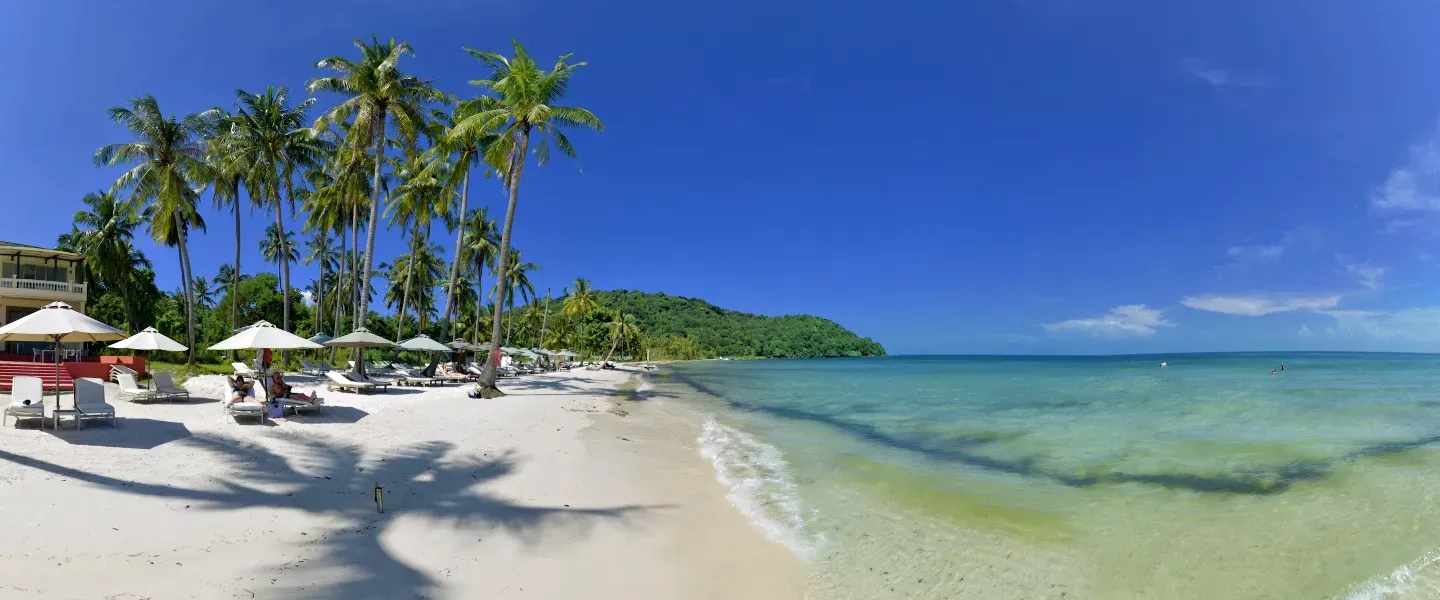
The beaches are the reason most people come, and the best of them work when you accept what kind of island this has become. Sao Beach can still give you that white-sand, shallow-water postcard moment, but it sits beside beach clubs, paid loungers and the usual scramble for the cleanest corner. The An Thoi Islands are better for a day on the water, with snorkeling stops, speedboats and coral that is fine as long as you are not expecting much. Come for easy sea days, not wilderness.
Duong Dong is where the island feels least packaged, especially around the night market when the seafood tanks start bubbling and everyone is pretending they know exactly which crab is fairly priced. The food here is best when it stays simple: grilled shellfish, peppery dipping salt, noodle shops with plastic stools, and fish sauce used like punctuation. It is not a town built for wandering slowly, and the nicest meal might still come with scooter noise at your elbow. That is part of the deal.
Travelers who want a polished beach base, kid-friendly resorts and short bursts of island-hopping will understand Phu Quoc quickly. Travelers hunting for empty coves, slow village rhythms or the rougher romance of a backpacker island will probably start complaining by the second taxi ride. The north and interior still have quieter roads, pepper farms and forest edges, but they do not cancel out the southern mega-developments or the resort-strip sprawl. Choose it for ease. Do not choose it for purity.
Sunset Syndrome
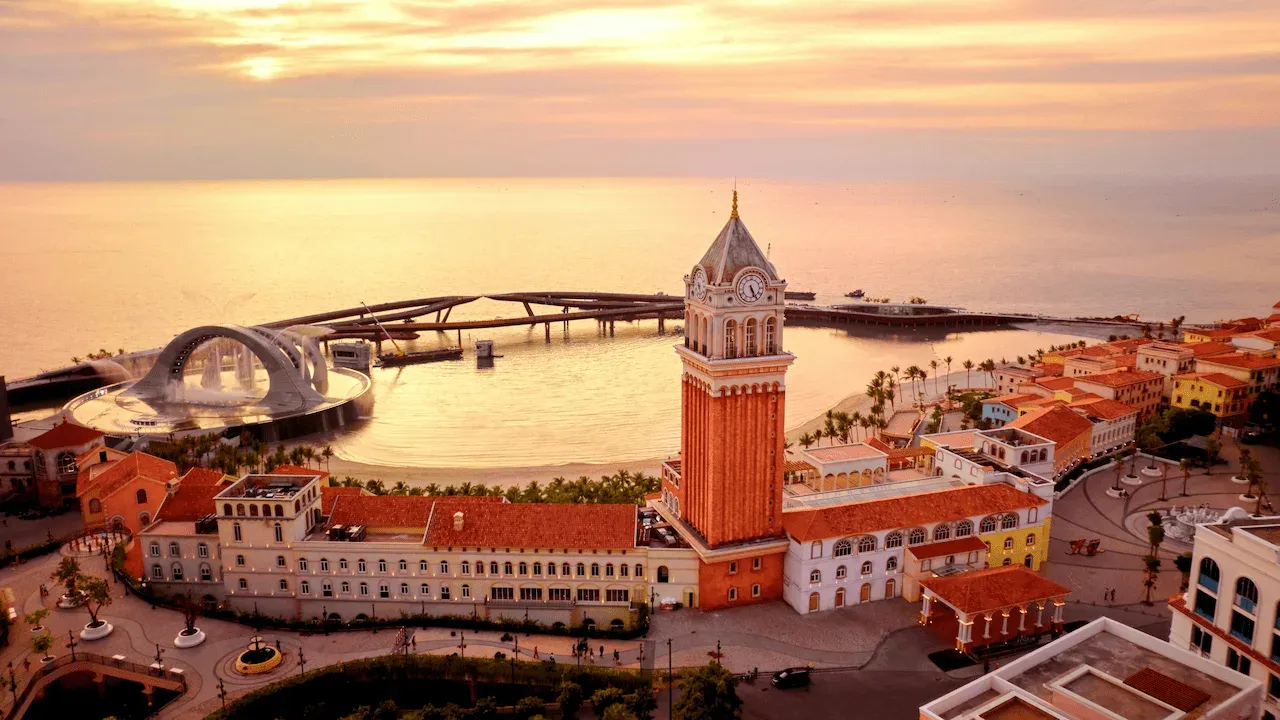
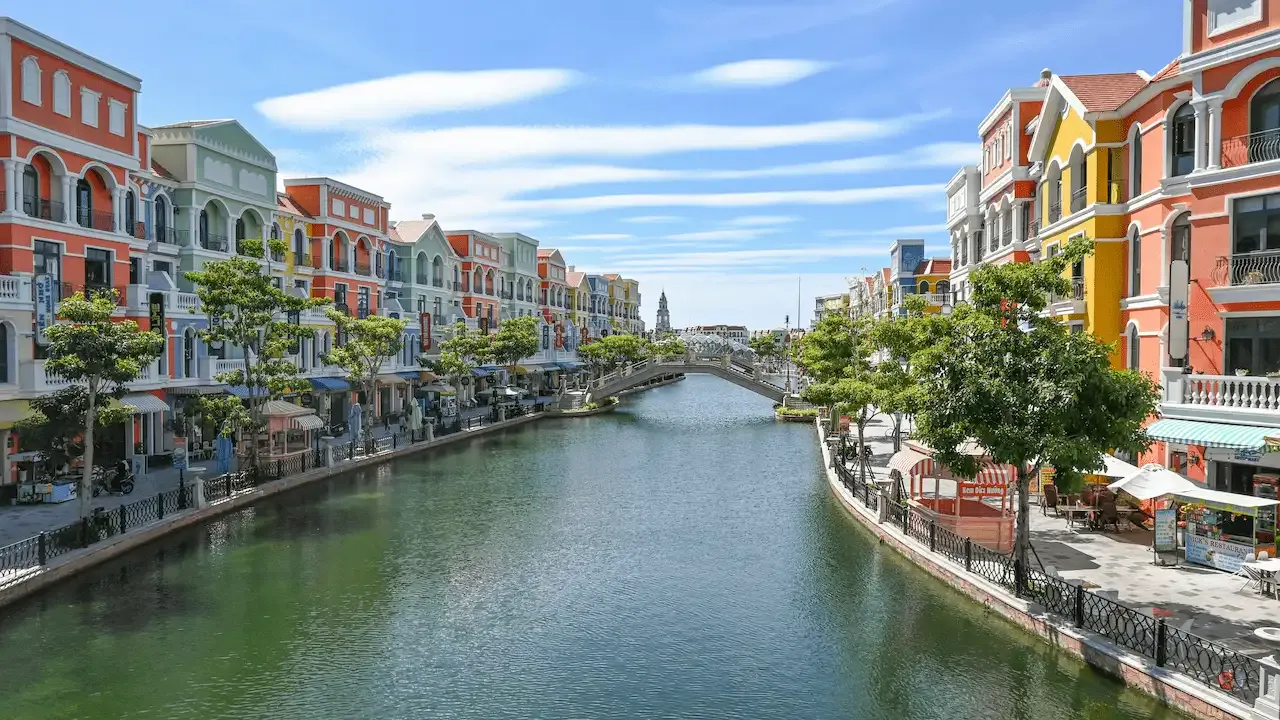
Sunset Town is where Phu Quoc stops pretending to be a beach island and admits it wants to be a stage set. You arrive to pastel facades, Italianate staircases, clock towers, empty balconies and streets built for photos before daily life has had any chance to move in. Around dusk, the place starts to make more sense: people drift toward the sea, cameras come out, the show lighting warms up, and the whole thing becomes less a town than a controlled backdrop. That is not an insult. It is just the product.
The strange part is how quickly the illusion thins once you step away from the main angles. A cafe terrace may face a sculpted square, but behind it are locked shopfronts, echoing sidewalk and the feeling of a resort brochure stretched over a real island. Some travelers love the neatness because it removes the usual Phu Quoc friction: no market puddles, no scooter squeeze, no seafood tank negotiations. Others feel cheated by the cleanliness. Sunset Town works best when you treat it as theater, not neighborhood.
Go in the evening if you go at all. The heat is lower, the emptier corners look less awkward, and the water-facing showpiece finally has a reason to exist. Do not spend your whole south-island day there unless manufactured spectacle is exactly what you came for, because Sao Beach, An Thoi boats and the working edges of the island tell you more. Sunset Town is useful because it reveals the split inside Phu Quoc: one island still smells of fish sauce and rain drains, the other wants a lighting cue.
Where to Stay in Phu Quoc
- Theme parks, national park, remote resorts
Ganh Dau
Ganh Dau occupies the remote northwestern corner of the island, split between dense national park forest and massive corporate entertainment complexes. The region is highly isolated from the rest of the island, requiring a long drive to reach town or the airport. Accommodation ranges from secluded coastal hideaways to massive family casino resorts that operate as self-contained mini-cities. It works well if you want theme parks or deep isolation, but independent travel is difficult here.
Good for: Family entertainment complexes, remote relaxation, national park access.
Skip if: You want a central base to easily explore the whole island on a scooter.
- Boutique hotels, quiet beaches, independent dining
Ong Lang Beach
Ong Lang Beach sits north of the main town and maintains a lower profile with low-rise boutique resorts and smaller independent bungalows. The coast here is broken up by red dirt lanes and rocky outcrops, offering a slower pace than the southern resort strips. Dining is limited to a small cluster of village restaurants and hotel kitchens, meaning evening entertainment is minimal. Roads are unpaved in pockets but the area stays clear of mega-resort development projects.
Good for: Quiet beach stays, independent travelers, couples.
Skip if: You need extensive nightlife options or large shopping centers within walking distance.
- Night markets, local dining, urban traffic
Duong Dong
Duong Dong is the main commercial town on the island, acting as the primary hub for local administrative life and dense street commerce. Staying here trades away immediate resort tranquility for direct access to backstreet noodle shops, the central night market stalls, and banks. Scooter traffic is thick throughout the day and the central streets lack continuous footpaths. It remains the best base if you want to avoid relying purely on hotel restaurants and long taxi rides for dinner.
Good for: Local dining, independent exploration, finding cheap guesthouses.
Skip if: You want an isolated resort experience directly on a quiet stretch of sand.
- Resort strips, sunset bars, package tourism
Long Beach
Long Beach is a massive coastal strip stretching south from the main town, lined with large hotels and international resort developments. The northern section near town is packed with beach bars and western restaurants, while the southern reaches feature newer high-rise projects that require transport to leave. Sand quality is consistent but the beachfront is heavily built up and sun loungers dominate the shoreline. It offers the most straightforward tourist infrastructure on the island.
Good for: Sunset views, mid-range resorts, easy airport access.
Skip if: You want an untouched coast free from mass tourism and hotel blocks.
- Island transport, port town, fishing industry
An Thoi
An Thoi sits at the absolute southern tip of the island, operating primarily as a working port town and the launch pad for regional boat tours. The immediate area is dominated by the departure station for the overwater cable car and massive Mediterranean style real estate facades that remain mostly empty during the day. Staying here puts you close to the best snorkeling reefs in the southern archipelago, but daily dining options outside of hotels are limited. It feels like a transit zone rather than a relaxed beach base.
Good for: Island hopping trips, scuba diving, transit to southern islands.
Skip if: You want to walk out of your room directly onto a swimming beach with bars.
- Luxury enclaves, private beaches, resort dining
Khem Beach
Khem Beach is an upscale enclave on the southeast coast that has been entirely partitioned off by international luxury resort properties. The sand is exceptionally fine and kept clear of debris by the hotels, creating a private environment for travelers who do not plan to leave the property gates. There is no local town or street life accessible on foot, forcing reliance on upscale resort restaurants for every meal. Taxis are required for any exploration beyond the immediate bay.
Good for: Isolated luxury stays, honeymooners, private beach access.
Skip if: You are traveling on a budget or want authentic local neighborhood interaction.
- Day trips, white sand, shallow water
Sao Beach
Sao Beach is famous for its bright white sand and flat turquoise water, drawing thousands of day trippers who arrive by tour bus every morning. While fine for swimming, the beach suffers from heavy jet-ski noise and localized plastic waste issues depending on the season winds. Accommodation here is sparse and mostly basic, meaning the area goes quiet after the daytime crowds leave at dusk. It functions much better as a temporary day trip destination than a multi-night base.
Good for: Shallow water swimming, white sand photos, daytime beach lounging.
Skip if: You want a fully developed neighborhood with evening dining and walkable services.
- Seafood piers, stilt villages, shallow coast
Ham Ninh
Ham Ninh sits on the muddy east coast and is defined by its long wooden piers lined with overwater seafood restaurants. The coastline here is shallow and tidal, making it completely unsuitable for typical beach lounging or swimming. Visitors stay in low-key local guesthouses primarily to experience an active fishing village environment that has not been completely commercialized by large resorts. It gets busy during lunch hours when tour groups arrive for cheap shellfish, then returns to a slow pace at night.
Good for: Fresh seafood dining, local village perspectives, rural scenery.
Skip if: You expect perfect swimming beaches and international resort amenities.
Frequently Asked Questions
Planning & moving around
-
How many days should I spend in Phu Quoc?
Three or four days is enough for beaches, a boat trip, the night market and one inland loop without rushing. Stay five days if you want resort time, family downtime or a slower pace. More than that starts to feel repetitive unless you are working remotely or using the island as a soft landing.
-
What are the best day trips from Phu Quoc?
The An Thoi island trips are the headline day out, with speedboats, snorkeling stops and beaches such as May Rut and Gam Ghi. The Hon Thom cable car is worth doing if you are curious about the island's resort-spectacle side, not if you want untouched nature. A northern loop can include pepper farms, Ganh Dau and Rach Vem, but the starfish stops are less charming when crowds and shallow-water photo chasing take over.
-
Do you need a license to rent a scooter in Phu Quoc?
Shops may rent you a scooter without asking, but that does not make you legal or insured. For most tourist scooters over 50cc, you need a valid motorcycle license and an accepted international driving permit or Vietnamese license. If you do not have that, use taxis, app cars or hotel transfers.
-
How do you get around Phu Quoc without a scooter?
Use Grab, Xanh SM, taxis, hotel transfers and the resort-area bus routes rather than trying to walk between beaches. VinBus and Sun Bus connect some big attractions and resort zones, but they are not a complete island-wide fix. For families and late dinners, a car is often the least annoying option.
-
What ride-hailing apps work in Phu Quoc?
Grab works in the main tourist areas, especially around the airport, Duong Dong, Long Beach and larger resorts. Xanh SM is also useful when cars are available. In quieter parts of the island, have your hotel call a taxi or arrange a pickup.
-
What mistake do first-timers make in Phu Quoc?
They book the island expecting one compact beach town and then spend the trip in taxis between spread-out beaches, resorts and attractions. Pick your base around the kind of trip you want: Duong Dong for convenience, Long Beach for easy sand, the south for staged resort attractions. Changing areas every day wastes the island.
-
What do tourists get wrong about Phu Quoc?
They treat it as a quiet castaway island. The reality is a developed resort island with fish sauce yards, night-market smoke, mega-projects and pockets of real local life between hotel zones. Enjoy it more by dropping the purity test.
-
Is Phu Quoc worth visiting for quiet beaches?
Only if you choose your area carefully and keep expectations realistic. The famous beaches can feel managed, busy or patchy, while quieter stretches often need transport and still may not be spotless. If solitude is the point of the trip, Phu Quoc is a risky bet.
Safety & medical
-
Is Phu Quoc safe at night?
Yes, in the usual traveler zones, but it is not a place for careless late-night walking along dark roads. Duong Dong, Long Beach and resort areas feel comfortable after dinner, while unlit beach roads and scooter-heavy stretches are the weak points. Use Grab, Xanh SM, a taxi or your hotel transfer after drinks.
-
Is Phu Quoc LGBTQ+ friendly?
Tourist areas are relaxed enough for most LGBTQ+ travelers, especially in resorts, beach bars and international-facing restaurants. Public same-sex affection is still uncommon, and there is no meaningful LGBTQ+ scene on the island. Low-key behavior will draw less attention than trying to treat it like a party district.
-
What health issues should travelers watch for in Phu Quoc?
Seafood handling, dehydration, sunburn, mosquito bites and stomach trouble are the common problems. Night-market seafood should be hot, fresh and cooked through, and tap water is not drinking water. Mosquito repellent matters most around dusk, gardens, forest edges and wet-season stays.
-
Is travel insurance necessary for Phu Quoc?
Yes, especially if you plan to ride a scooter, take boat trips or travel with children. Serious injuries may need private care on the island or transfer to a larger mainland hospital. Insurance matters less for lost luggage and more for the road accident you hope never happens.
-
Where can children get medical care in Phu Quoc?
Vinmec Phu Quoc is the strongest private option for families, with hospital services and pediatric care on the island. Duong Dong also has clinics and pharmacies for routine problems. For serious cases, ask your insurer early about mainland transfer options.
-
Can you drink the tap water in Phu Quoc?
No. Locals and hotels use bottled, boiled or filtered water for drinking, and travelers should do the same. Ice in proper restaurants and resorts is usually commercially made, but tiny stalls are a judgement call.
-
Are mosquitoes bad in Phu Quoc?
They can be annoying, especially around gardens, forest edges, standing water and wet-season evenings. Dengue exists in Vietnam, so bites are not just cosmetic. Use repellent at dusk and choose rooms with screens, air-con or good sealing.
Laws & local norms
-
What are the drug laws in Phu Quoc?
Vietnam has strict drug laws, and Phu Quoc is not an exception because it feels like a resort island. Possession, trafficking and dealing can lead to severe prison sentences, and serious drug offenses can carry the death penalty. Do not buy, carry or accept drugs here.
-
Is vaping allowed in Phu Quoc?
No. Vietnam has banned e-cigarettes and heated tobacco products, including use, storage, trade and import. Travelers should not bring vapes into Phu Quoc or treat beach bars as a grey zone.
-
What should I wear at temples in Phu Quoc?
At Ho Quoc Pagoda and smaller shrines, cover shoulders and knees and remove shoes where locals do. Beachwear belongs at the beach, not inside religious spaces. The rule is simple: dress like you are visiting someone's place of worship, not passing through a photo stop.
-
What etiquette matters most in Phu Quoc?
Polite bargaining is normal in markets, but arguing hard over tiny amounts reads badly. Ask before photographing people, especially children and working vendors. In restaurants and family-run places, a calm tone gets you further than volume.
-
Can you photograph people in Phu Quoc?
Ask first, especially at markets, fishing villages and religious sites. Do not shove a camera into someone's workday because the light looks good. At ceremonies or shrines, skip flash and give people room.
Culture & etiquette
-
Why is fish sauce important in Phu Quoc?
Phu Quoc fish sauce is one of the island's old signatures, made from anchovies aged in large wooden barrels. You smell that working economy around parts of Duong Dong before you read about it on a label. It gives the island more identity than another beach club.
Food & drink
-
Where do locals eat in Phu Quoc?
Bun Quay Kien Xay is the obvious local-food stop, especially for the island's stirred noodle soup. Duong Dong's smaller noodle shops, seafood grills and market-side stalls are often more useful than the polished resort restaurants. Rach Vem floating restaurants can be fun, but go for the setting as much as the food.
-
What dishes should I try in Phu Quoc?
Start with bun quay, the stirred seafood noodle soup that makes the island feel different from a generic beach stop. Ham Ninh crab, herring salad, crab fried rice and grilled seafood with chilli salt are also worth chasing. Phu Quoc pepper and fish sauce show up quietly, but they do a lot of the work.
-
Are there good vegetarian or vegan options in Phu Quoc?
Vegetarian food exists, but it takes more work than in larger Vietnamese cities. Look for chay restaurants and dishes around Duong Dong, and ask clearly because fish sauce, seafood stock and egg can slip into otherwise vegetable-heavy meals. Resort restaurants are easier for strict dietary needs, but less interesting.
Families & kids
-
Is Phu Quoc good for families with young kids?
Yes, if you choose the right base and accept that the island is easiest by taxi or resort transfer. Shallow beaches, big resorts, VinWonders, Aquatopia and Vinpearl Safari make it one of Vietnam's easier beach trips with children. It is weaker for stroller wandering, local immersion and car-free family travel.
-
Is Phu Quoc stroller-friendly?
Resorts, malls and newer southern developments are stroller-friendly enough. Older parts of Duong Dong, market lanes, beach paths and broken sidewalks are not. Bring a baby carrier if you plan to eat locally or move beyond resort grounds.
Staying longer
-
Where should first-timers stay in Phu Quoc?
Duong Dong is the easiest first base if you want restaurants, markets, shops and transport close by. Long Beach works better if you want sand and sunset bars near your hotel. The southern resort zones suit families and packaged trips, but they feel more staged and less useful for everyday wandering.
-
Is Phu Quoc good for digital nomads?
It works for a short remote-work stay, not as a deep nomad hub. Duong Dong has cafes, gyms and a few coworking options, while Ong Lang and Cua Lap feel calmer but thinner on work infrastructure. Test the Wi-Fi before booking a long stay, especially outside bigger hotels.
After dark
-
What is nightlife like in Phu Quoc?
Nightlife is easygoing rather than wild, with Long Beach bars, Duong Dong's night market and resort lounges doing most of the work. Ocsen, Rory's-style beach bars, Grand World and INK 360 cover different versions of the evening. It is not a serious clubbing island.
-
What changes after dark in Phu Quoc?
The island shifts toward seafood grills, night markets, beach bars and staged resort entertainment. Dinh Cau Night Market gets busy with food, souvenirs and tourist prices, while darker roads between resort zones feel less forgiving. Plan the ride home before you start drinking.